Artist management software: what it covers, what it misses, and the gap most artists ignore
Artist management software covers scheduling, royalties, and analytics, but most tools leave out the layer that matters most: fan data. Understand what to look for and where the gap usually is.
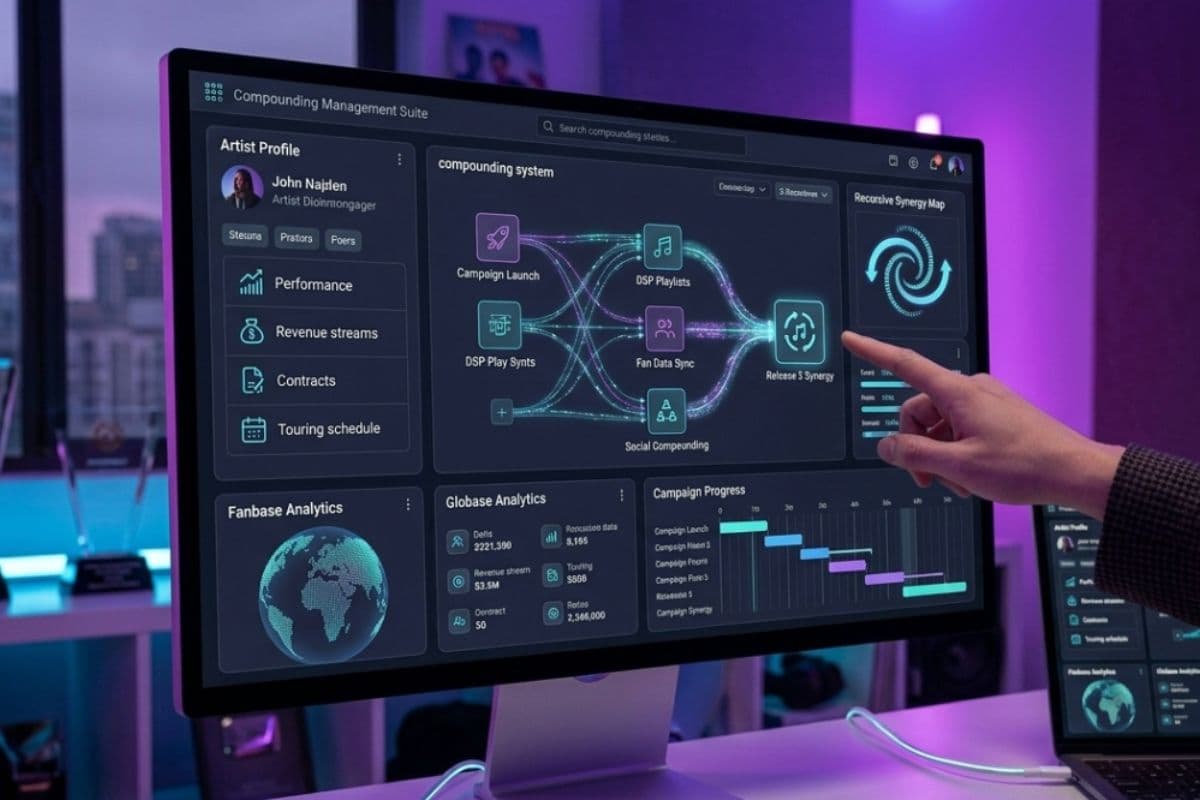
Artist management software has become part of the standard independent artist infrastructure, and for good reason. The administrative complexity of running a music career in 2026 is not trivial.
Release timelines, royalty tracking, booking coordination, content calendars, team communication: without a system, these tasks consume the hours that should go to music.
But most artist management software is built around the career management problem. The fan data problem is a different one, and most tools that solve the first one do not solve the second.
What artist management software is actually built to do
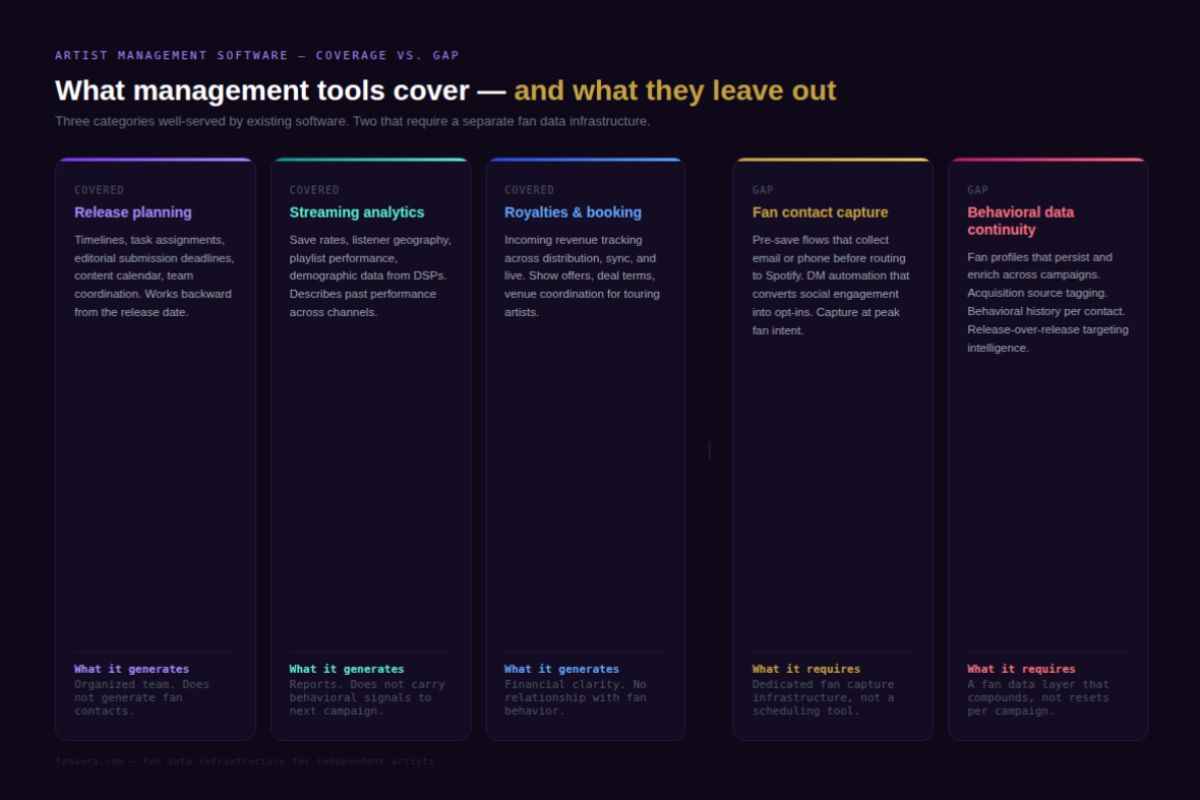
The category covers four operational functions. Understanding what each one does makes it easier to identify where the gaps are.
Release planning is the most common starting point. Tools in this category build timelines that work backward from a release date - editorial submission deadlines, artwork delivery, pre-save campaign activation, content schedule - and assign tasks to team members.
This is coordination infrastructure. It ensures the right things happen in the right order. It does not generate fan data.
Analytics and streaming intelligence platforms pull data from Spotify for Artists, Apple Music, YouTube, and social channels into unified dashboards.
They surface save rates, listener geography, playlist performance, and audience demographics. This is reporting infrastructure. The data describes what happened.
It does not automatically carry behavioral signals into the next campaign's targeting.
Royalty and financial tracking manages incoming revenue across distribution partners, sync placements, and live performance. For artists with complex income streams, this is genuinely essential. It is accounting infrastructure. It has no relationship with fan behavior.
Booking and contract management coordinates show offers, deal terms, and venue relationships. Useful for touring artists. It is logistics infrastructure.
All four categories serve real needs. None of them build a fan relationship. None of them capture an email address, trigger a DM flow, build a pre-save opt-in, or produce an owned contact the artist controls past a platform's algorithmic decisions.
The gap between managing a career and owning a fanbase
A well-organized career and an owned fanbase are not the same thing. An artist can have a perfectly managed release schedule, clean royalty accounting, and a beautifully structured content calendar, and still have zero direct access to the listeners who streamed their last three releases.
That gap exists because most artist management software is designed around the artist's operational workflow, not the fan's journey. The release gets planned. The content gets scheduled. The analytics get reviewed.
But the moment of highest fan intent - a listener who just heard the track on a creator's TikTok and is ready to engage - passes without any infrastructure in place to capture it.
The fans who convert to owned contacts do so through specific mechanisms: a pre-save flow that collects email or phone before routing to Spotify, a DM automation that fires when they comment a keyword, an opt-in on a landing page that offers something in exchange for their contact detail.
None of these mechanisms live inside traditional artist management software. They require a separate layer - one built around fan capture, not career coordination.
What to look for when evaluating artist management software
The evaluation frame that produces useful decisions: does this tool help me coordinate my work, or does it help me own my audience? Both matter. Most tools do one. Very few do both.
For the coordination layer, the questions that matter:
Does it integrate with the DSPs I actually use, or does it require manual data entry to keep analytics current?
Does the task management system make it easy for a small team - two to three people - to stay aligned without an operations background?
Does it generate release timelines that account for the actual lead times of editorial pitching, press outreach, and playlist submission, or does it just create a calendar?
For the fan data layer, the questions most artists forget to ask:
Does the tool capture fan contacts from pre-save campaigns, or does it only track pre-save counts?
Does it have DM automation that connects social engagement to an owned contact list?
Does behavioral data from one release - saves, merch purchases, story replies - carry into targeting for the next one?
If the answer to the second set of questions is no - and for most artist management software, it is - the tool needs to be paired with a separate fan capture infrastructure.
Managing the career and owning the fanbase require different systems. The artists who build both are the ones whose marketing gets cheaper and more effective over successive releases.
How the two systems work together
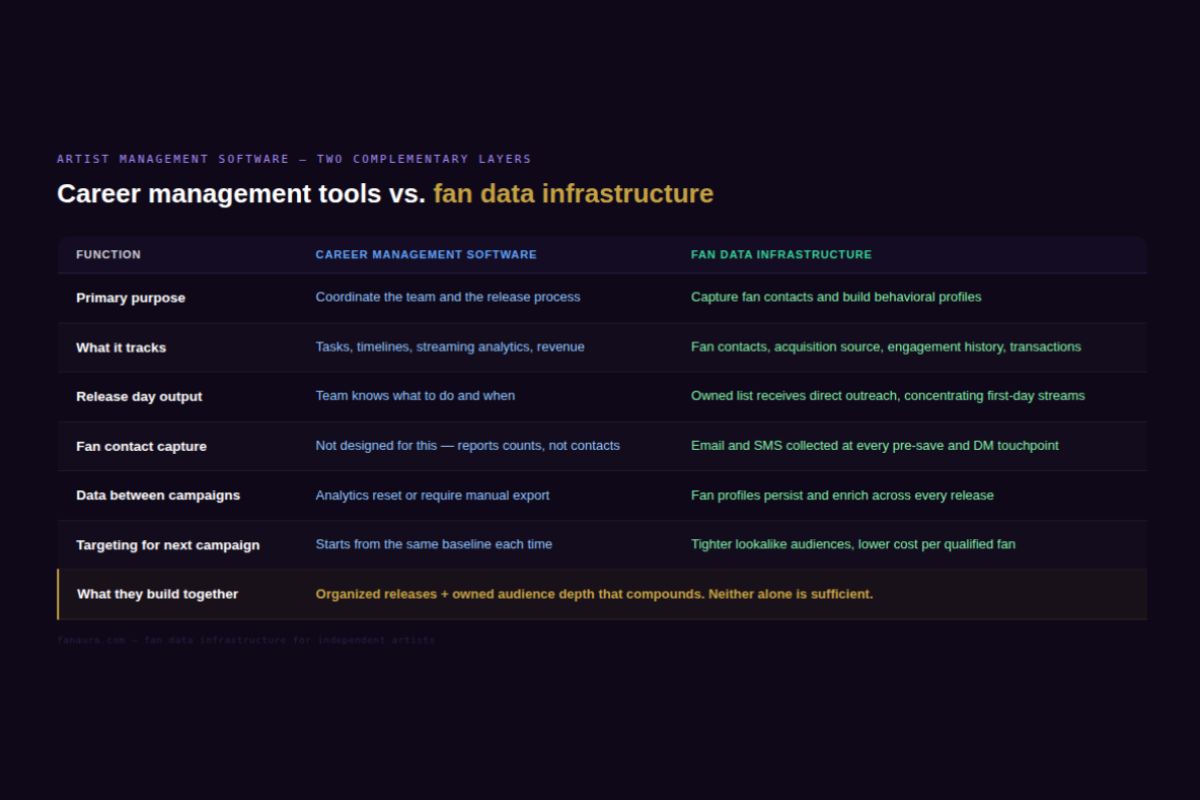
The coordination layer and the fan data layer are complementary, not competing. The release plan tells the team when to activate. The fan data layer tells the team who to reach, what they've responded to, and what they're most likely to act on next.
A release planned in artist management software runs better when the team knows, going into week one, that 800 people from a previous release are already opted in, geographically clustered in three cities, and historically responsive to early access offers.
That behavioral intelligence is not something a scheduling tool generates. It comes from having treated every previous release as a data-gathering exercise.
The music release strategies that compound over time are the ones where both systems run simultaneously - the coordination layer keeping the team organized, and the fan data layer building owned audience depth with every campaign.
Where Fanaura fits in the artist management stack
Fanaura is not an artist management software replacement. It is the fan data layer that most management tools leave out - the infrastructure that captures what happens between a listener discovering the music and becoming a contact the artist owns.
What Fanaura adds to the stack:
Pre-save flows with opt-in capture - every pre-save campaign generates owned contacts, not just pre-save counts reported to a dashboard
Instagram DM automation - keyword-triggered flows that convert social engagement into email and SMS contacts automatically
Fan profiles with behavioral history - not just contacts, but records of how each fan was acquired, what they engaged with, and how they've responded across releases
Release-over-release data compounding - save patterns, merch purchases, and geographic clustering feeding back into targeting for every subsequent campaign
Pair it with whatever scheduling and analytics tools already work - then add what they cannot do. Start building your fan data layer with Fanaura at fanaura.com - and make your next release the first one that leaves owned contacts behind.
Take the next step in your music career
Build your career with a marketing team behind you.
Create your account and start planning your next release with Aura Chat.