Best music CRM: what fan relationship management actually requires in 2026
The best music CRM is not the one with the most features. It is the one that captures fan behavior, not just contact details, and makes that data actionable across every release.

The best music CRM is not a generic contact manager with a music skin over it. It is a system built around the specific way fans relate to artists - through discovery events, engagement moments, and transactions that signal intent - and capable of turning those signals into targeting intelligence that compounds across releases.
Most CRM discussions in music start with the wrong question: which tool has the most features? The right question is which tool captures the right data - and then makes that data useful for the next release, not just the current one.
Why generic CRMs fail musicians
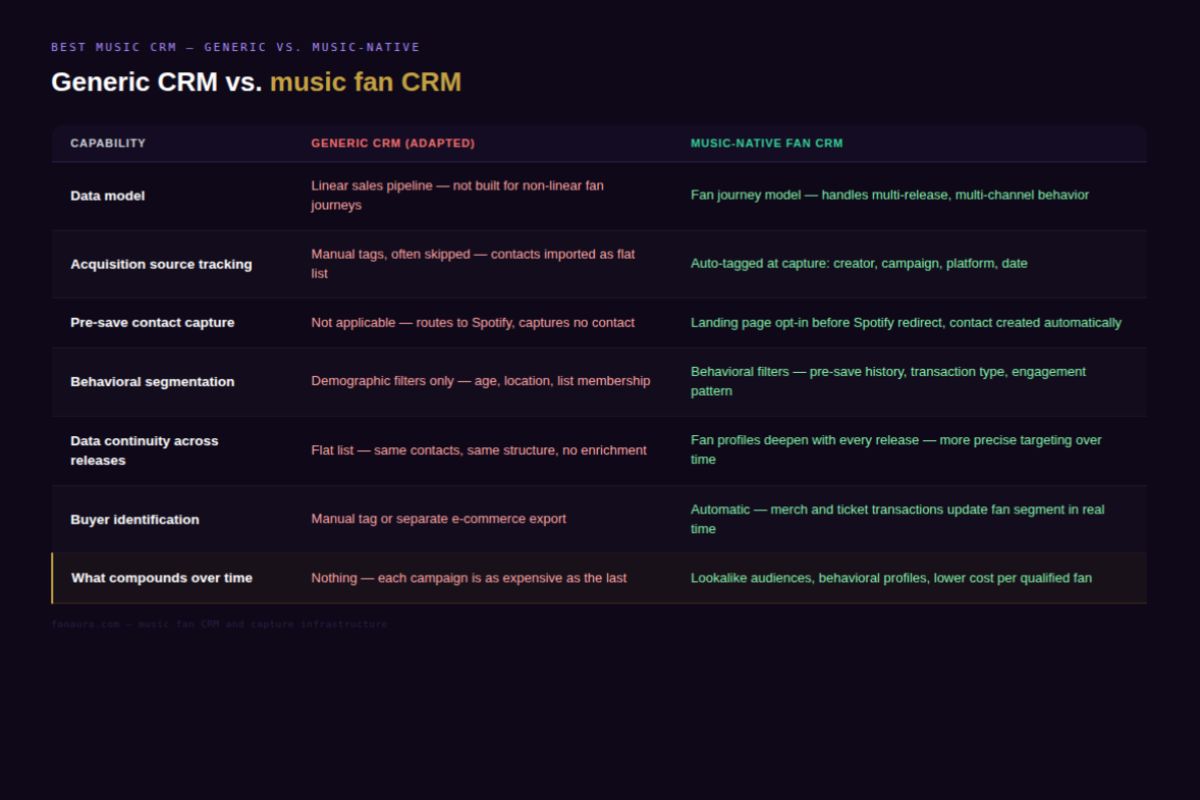
A general-purpose CRM - HubSpot, Zoho, even MailChimp with tags - can technically hold contact records for fans. An artist can import an email list, segment it by geography, and send a broadcast.
That is not a music fan CRM. That is a mailing list with extra steps.
The problem is structural. Generic CRMs are built around a linear sales process: lead enters, lead is nurtured, lead converts. Fan relationships do not work linearly. A fan might discover an artist through a TikTok, save the track, ignore the next release, buy merch eight months later after a live show, and then become a consistent pre-saver for everything that follows.
That non-linear arc contains rich behavioral data - but only if the system was built to capture it at each touchpoint, not just at a single opt-in moment.
Generic CRMs also treat all contacts as equivalent. A fan who found the artist through a niche TikTok creator behaves differently from one who discovered the track on an editorial playlist and differently again from one who bought merch at a show.
Those acquisition sources predict future behavior. A system that does not tag them at the point of capture is discarding intelligence that would have made every subsequent campaign more precise.
What the best music CRM actually tracks
The behavioral signals that define a useful fan CRM are not complicated. They are specific, and most tools either do not capture them or capture them in silos that cannot communicate with each other.
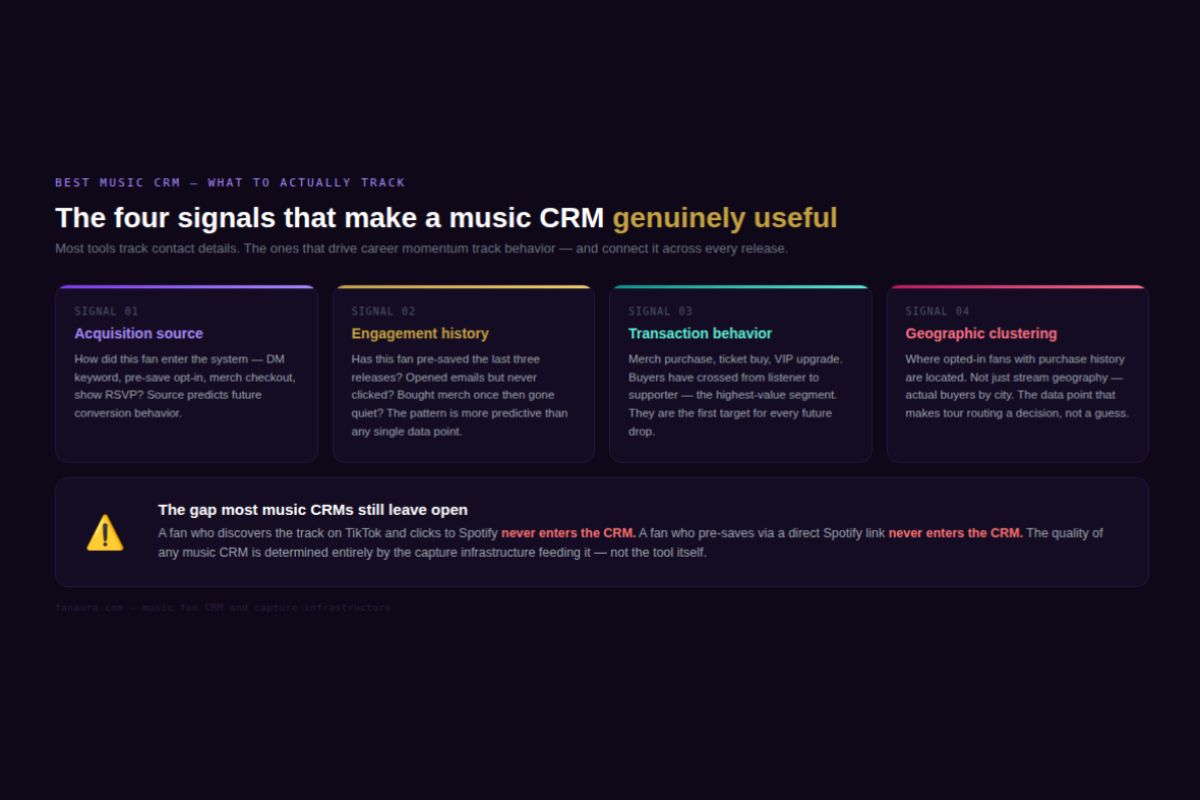
Acquisition source is the first data point that matters. How did this fan enter the system - a DM keyword trigger, a pre-save opt-in, a merch purchase, a show RSVP? The source predicts conversion probability on future campaigns.
Fans who entered through a keyword DM behave differently from fans who entered through a QR code at a merch table. A music CRM that does not tag acquisition source is treating all fans as interchangeable.
Engagement history across releases is the second. Has this fan pre-saved the last three releases? Opened every email but never clicked through? Bought merch once and gone silent? The pattern is more predictive than any single data point.
A fan who pre-saves consistently is the fan to notify first for the next release. A fan who bought merch but has not engaged since is a re-engagement candidate, not a primary outreach target.
Transaction behavior - merch purchases, ticket buys, VIP upgrades - tells the system who has crossed from listener to buyer. Buyers are the highest-value segment in any music fanbase.
They have demonstrated willingness to spend, which makes them the correct target for every future drop, presale, and limited offering.
A music CRM that does not distinguish buyers from non-buyers is sending the same message to people with fundamentally different relationships to the artist.
Geographic clustering surfaces the markets where the fanbase is concentrating, not just where streams come from, but where people with contact details and purchase history are located.
A market with 200 opted-in fans who have bought merch is a tour routing data point. It is not visible in streaming analytics. It only appears when the CRM connects acquisition data with transaction behavior with geography.
The fan CRM features that actually matter
Evaluated against the behavioral signals described above, the feature set that defines a genuinely useful music CRM is specific:
Multi-channel contact capture - email, SMS, and DM opt-ins collected from pre-save flows, Instagram automations, merch checkouts, and show sign-ups, all consolidated into the same fan profile
Acquisition source tagging - automatic recording of how each fan entered the system, which creator or campaign drove them, and which platform the interaction happened on
Behavioral history per contact - a timeline of every touchpoint: pre-saves, email opens, link clicks, merch purchases, event RSVPs, and story replies
Segmentation by behavior - the ability to build audiences from behavioral filters, not just demographic ones: "fans who pre-saved the last two releases and have not yet bought merch" is a segment worth targeting specifically
Release-over-release data continuity - fan records that persist and enrich across campaigns, not a flat list that starts over with each new release
The tools that check all of these boxes are almost exclusively built natively for music - because generic CRMs were not designed around the non-linear, platform-spanning nature of how fans and artists connect.
The gap most music CRMs still leave open
Even the most music-native CRM tools tend to manage contacts well and capture engagement history reasonably. The gap that remains is the moment of peak intent - the window between a fan encountering the music and entering the system as a contact.
A fan who discovers a track through a TikTok creator and clicks to Spotify never enters the CRM. A fan who reads a press feature and goes to stream never enters the CRM. A fan who gets a pre-save link that routes directly to Spotify never enters the CRM. The CRM only knows about the fans who were explicitly captured - through a landing page opt-in, a keyword DM trigger, or a transaction.
This means the quality of the fan CRM is directly determined by the quality of the capture infrastructure feeding it. A world-class CRM fed by weak capture mechanisms will have thin, incomplete fan profiles.
A simpler CRM fed by a strong pre-save opt-in flow, a DM automation on every creator post, and a merch checkout with list sign-up will accumulate behavioral intelligence that compounds with every release.
The fanbase growth that produces compounding returns happens at the intersection of capture and relationship management - and both have to be strong.
How Fanaura functions as the music CRM built around capture
Fanaura's fan data architecture is built around the signal gap that standard CRMs leave open - the moment between discovery and contact capture.
Every fan who interacts with a Fanaura-powered DM trigger, lands on a Fanaura pre-save page, or completes a merch transaction through a connected flow enters a structured fan profile that records:
How they were acquired - which creator, campaign, platform, or trigger brought them in
What they did - pre-saved, opted in, bought merch, RSVPed, opened an email
When they did it - timestamps across every interaction, building a behavioral timeline per fan
What comes next - behavioral patterns feeding into segmentation for the next campaign's targeting
That intelligence does not sit in a report. It actively shapes who receives what message, at what time, on the next release - making each campaign cheaper to run and more precisely targeted than the last.
Stop managing fans in a spreadsheet or a generic email tool. Build your music CRM with Fanaura at fanaura.com - capture the behavioral data that generic tools miss and make every release smarter than the one before it.
Take the next step in your music career
Build your career with a marketing team behind you.
Create your account and start planning your next release with Aura Chat.