Best music marketing platform: how to choose the right tools for each stage of a release
Learn what the best music marketing platform actually does, which categories matter, and how to build a stack that owns fan data across every release.

The best music marketing platform is the combination of tools that covers discovery, fan capture, and direct communication without leaving gaps between them.
Independent artists now hold over 40 percent of global recorded music market share, according to Orphiq's 2026 music industry report.
That shift happened because the tools available to artists outside major label structures finally caught up.
Distribution is no longer the bottleneck. The bottleneck is knowing which platforms actually build something that carries forward - and which ones reset with every release.
What separates a music marketing platform from a promotion tool
The best music marketing platform does something most promotion tools skip: it turns the listener who found you into a contact you own.
Most platforms artists encounter fall into one of two categories - tools that generate reach, and tools that generate data. A promotion tool moves people toward your music.
According to AMW's 2026 streaming statistics, 75 percent of Gen Z listeners discover new music through platform algorithms and curated playlists. Reach is not optional. But reach without a capture mechanism is borrowed attention.
A music marketing platform, in the fuller sense, stores what the listener did - whether they saved the track, clicked through to merch, or RSVPed to a show - and uses that behavior to sharpen the next campaign. The difference is whether the system learns.
Most artists run four or five tools that never talk to each other: a distributor, a playlist pitching service, a social scheduler, an email platform, and a smart link tool.
Each one collects a fragment of data. None of them consolidate it into a picture of who the fan actually is. Most music promo budgets reset with every release instead of compounding.
The categories every artist needs to cover
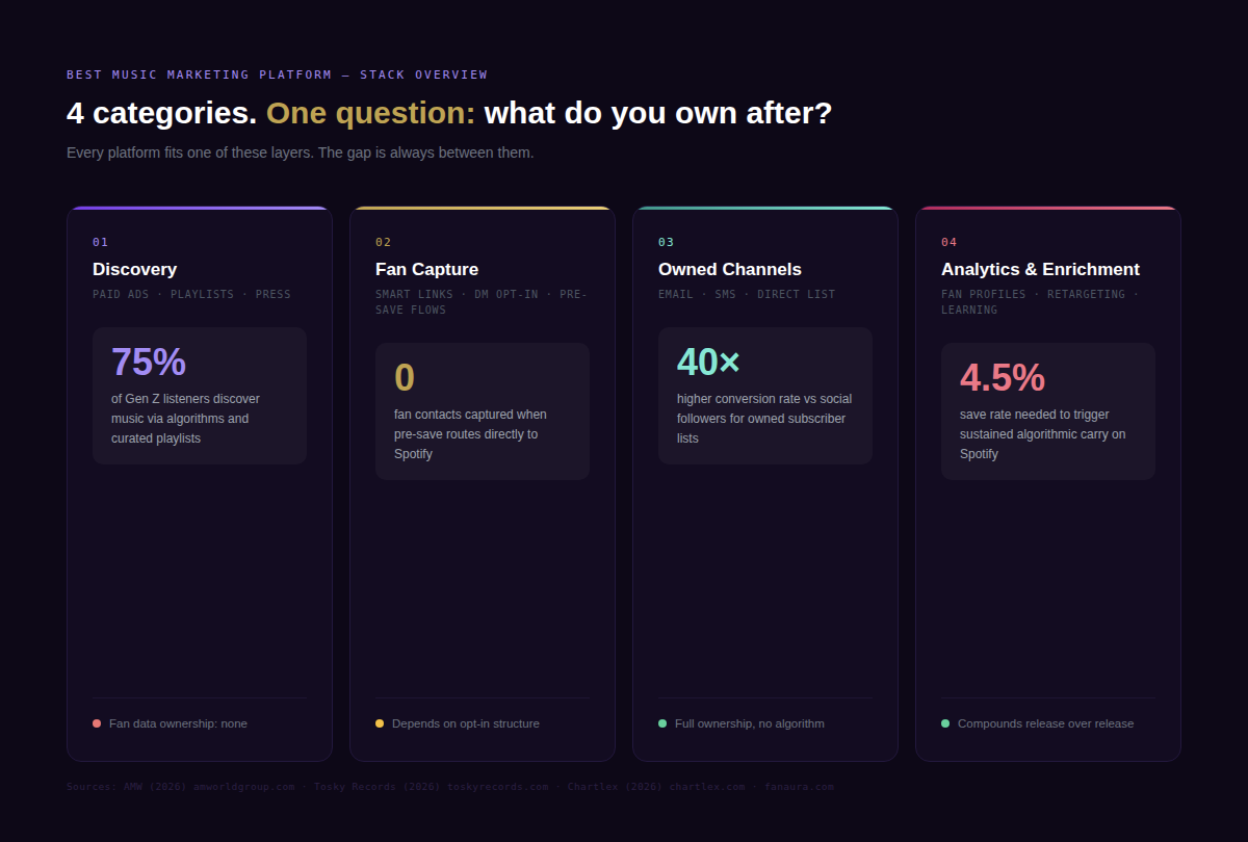
Before evaluating any specific platform, it helps to map the functional gaps a full stack needs to fill. Four categories are non-negotiable for a music marketing platform that compounds over time:
Discovery tools move listeners toward your music. This includes paid advertising (Meta, TikTok), playlist pitching services (Groover, SubmitHub), editorial pitching through Spotify for Artists, and press outreach. According to Chartlex's 2026 industry analysis, tracks holding a 4.5 percent save rate consistently earn sustained algorithmic carry on Spotify - which means discovery tools need to generate qualified intent, not raw plays.
Fan capture tools convert discovery into a contact you own. Smart link platforms, pre-save flows with opt-in mechanisms, and DM automation systems fall here. A pre-save link that routes fans directly to Spotify captures zero contact data - the platform retains everything. A pre-save flow with an email or SMS opt-in captures the fan at the moment of highest intent, before the platform absorbs them.
Owned communication channels - email and SMS lists - are the only layer that operates independently of algorithm changes. According to Tosky Records' 2026 analysis of direct-to-fan economics, an owned mailing list converts at rates 10 to 40 times higher than social media followers. A subscriber opted in, which means their attention is not competing with thousands of other posts.
Analytics and enrichment tools close the loop. They tell you which fans bought merch, which saved the track but never returned, and which markets are building momentum you have not yet capitalized on. Without this layer, each release is a fresh start. With it, each release teaches the system something the previous one could not.
How the best platforms handle fan data
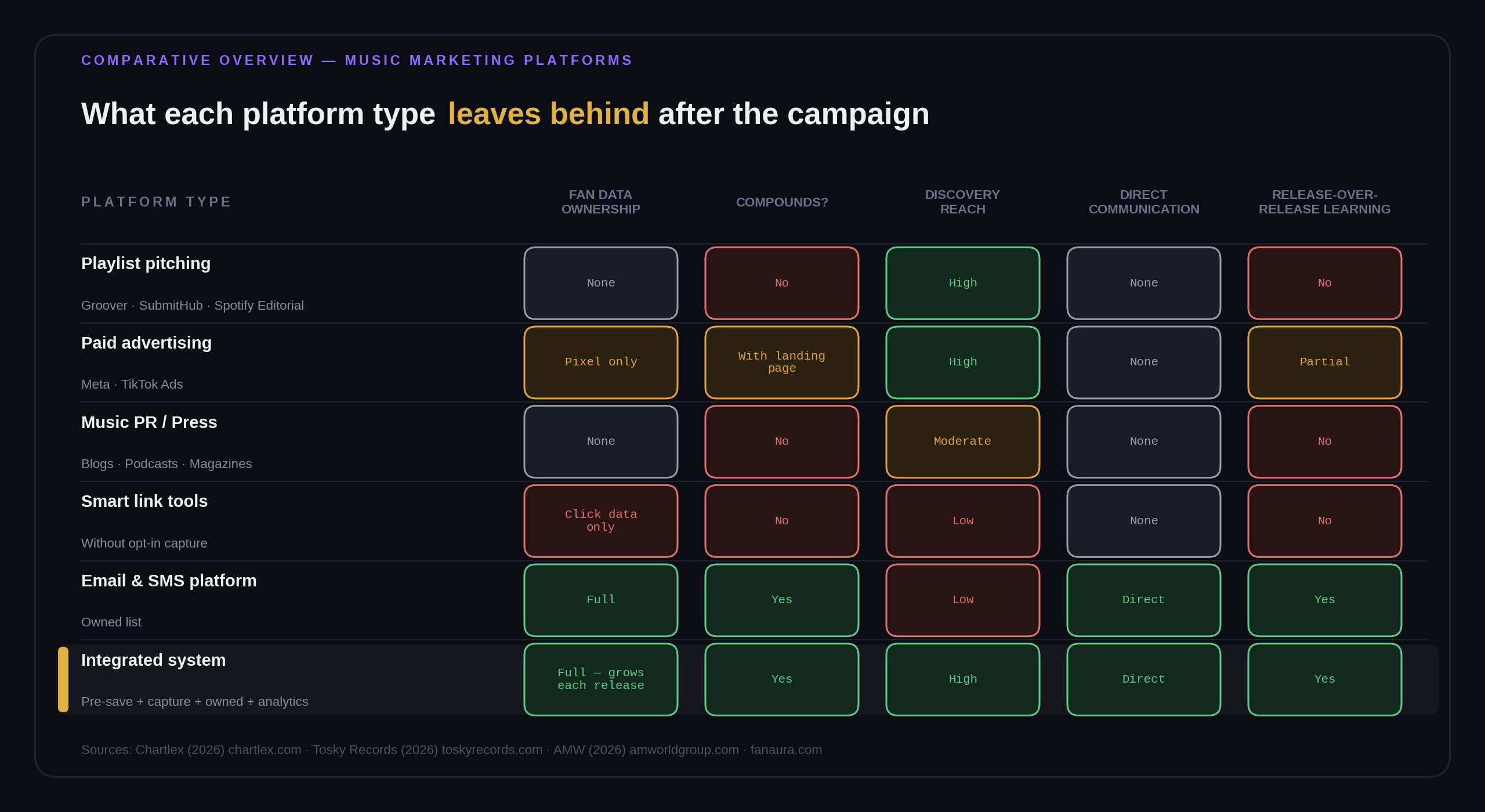
The question that separates commodity tools from genuine music marketing platforms is a simple one: after the campaign ends, what do you own?
Most promotion platforms answer that question the same way: you own the results, not the audience.
A music PR company delivers a press placement and the credibility that comes with it. The readers who discover you through that placement belong to the outlet - their contact information, location data, and behavioral signals stay on the platform's side of the equation.
The same is true for streaming platforms. According to Spotify's Loud & Clear data, reported by Hypebot (2026), Spotify drove over $1.5 billion in gross concert ticket sales for artists.
That is a meaningful number - but it represents revenue Spotify facilitated, not fan relationships the artist controls. The moment an artist stops releasing consistently, that surface area shrinks.
The platforms worth building around are the ones that make fan data portable and cumulative.
Every pre-save opt-in, every merch transaction, every keyword DM trigger should add to a profile the artist fully controls - regardless of what any algorithm decides next cycle.
What to look for before committing to a platform
Most teams evaluate platforms by their top-line metric: streams driven, placements secured, open rates. Those numbers describe what the tool did on a single campaign.
The more useful question is what the platform leaves behind after the campaign ends.
A few criteria worth applying before committing to any music marketing platform:
Data portability: can fan contacts, behavioral data, and engagement history be exported in a usable format - or does that data live only inside the platform?
Channel integration: does the platform connect what fans do across touchpoints - a DM opt-in, a pre-save, a merch click - into a unified fan profile, or does each action live in its own silo?
Release-over-release learning: does the platform use data from past campaigns to improve targeting and reduce cost on future ones, or does each release start from scratch?
Owned channel support: does the platform make it easy to build and communicate with an email or SMS list - channels the artist controls - or does it route everything through third-party surfaces?
The best way to advertise music is not the platform with the largest network or the most impressive reach numbers. It is the one that turns each campaign into infrastructure for the next one.
How to build a stack that compounds with every release
The artists who see consistent returns from music marketing are not necessarily spending more - they have built infrastructure that makes spending efficient, and Fanaura is built around exactly that gap.
The platform connects music launches, merch drops, and tour campaigns into a single system.
A fan who interacts with a keyword trigger via Instagram DM or SMS is captured into a structured fan profile. Every subsequent touchpoint enriches that record:
Pre-save opt-ins captured before streaming platforms absorb the fan
Merch and tour RSVPs feeding behavioral data back into the fan profile
Owned email and SMS lists built from every release, operating independently of algorithm shifts
Lookalike audiences tightening with each campaign, reducing cost per qualified fan over time
That structure is what turns a series of disconnected campaigns into a compounding release system - one where each launch is cheaper, faster, and more precisely targeted than the one before it. A stack that resets with every release will always spend more to achieve less.
If the current approach leaves no fan data behind, that is the gap worth closing first. Explore how Fanaura structures the full launch cycle.
Take the next step in your music career
Build your career with a marketing team behind you.
Create your account and start planning your next release with Aura Chat.