Centralizing music marketing: how to connect channels so data actually accumulates
Centralizing music marketing routes every channel's data into one shared fan layer. When that layer exists, each campaign builds on the last.
Centralizing music marketing is a structural decision about where data flows after something happens on a channel, and whether any of it reaches a place the artist can act on.
Most artists run promotional channels in parallel: ads on Meta, playlists pitched through Groover, press via a publicist, email through Kit or MailChimp.
Each tool generates data. None of it flows to the others. The artist ends the campaign with an open rate, a stream count, and an ad spend figure, but no answer to the question that determines whether the next campaign will be cheaper or more expensive: which activities produced which fans, and what did those fans do next.
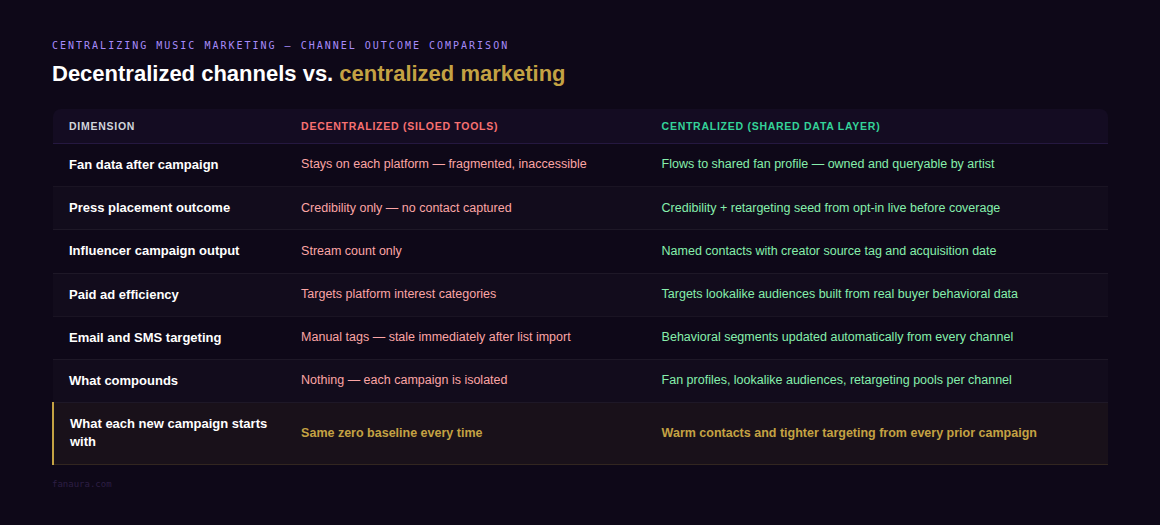
What happens to data when channels do not share it
Every channel generates reach. Reach events that do not connect to a shared data layer produce numbers, not compounding intelligence.
A fan who discovers an artist through a press feature and clicks through to Spotify generates a stream. That stream lives in Spotify's analytics.
The fan's contact, location, and discovery context stay with the outlet and the platform. The artist's data layer never learns this fan exists.
A fan reached through a TikTok creator campaign generates a view and a stream. The view is in TikTok's analytics. The stream is in Spotify's analytics. The artist learns neither who this fan is nor how they arrived.
A fan who discovers the artist through an Instagram Reel, clicks the bio link, and streams is visible in Instagram's analytics, the smart link tool's analytics, and Spotify's analytics simultaneously.
Three datasets, zero shared record, no contact the artist can act on. The channels produced events. The events did not accumulate.
What centralization actually requires
Centralization is an infrastructure decision, not a software purchase. Three choices applied consistently across every channel:
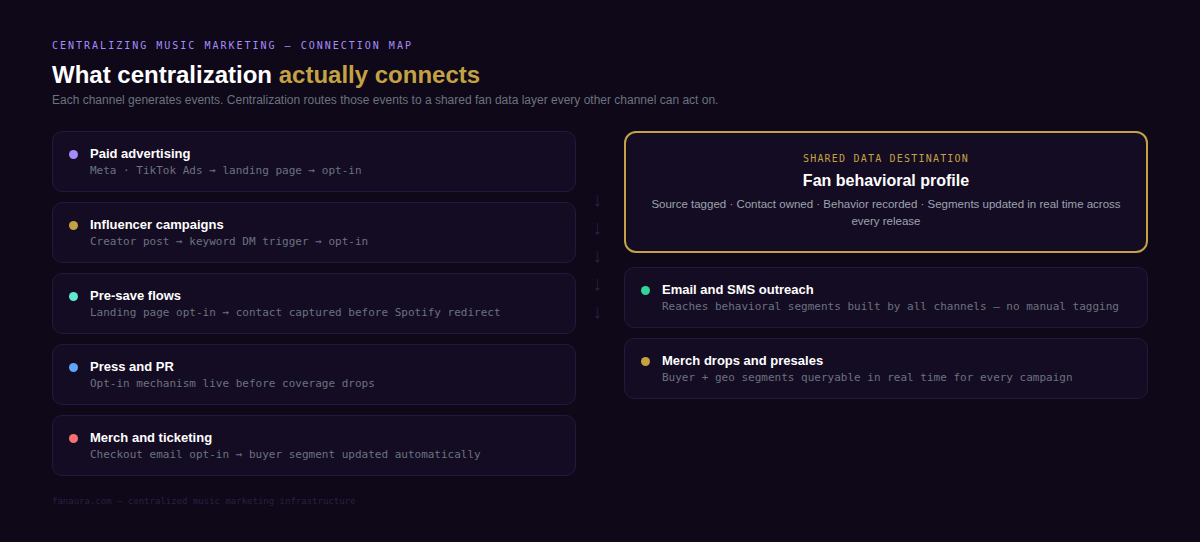
Every channel needs a capture mechanism that routes to the same destination. A TikTok campaign routes traffic to a landing page with an opt-in, not to Spotify. An Instagram creator post uses a keyword trigger that fires a DM flow. A merch checkout collects email before completing the order. A show RSVP requires contact detail before confirming attendance.
Every capture event needs to record its source. Source tagging at acquisition is what allows the system to answer which channel produced the fans who actually convert. A contact who entered through a creator DM and one who entered through a merch purchase predict different future behaviors, even if they are the same person at a later stage.
The shared data layer needs to be queryable, not just archival. A system that stores behavioral history but cannot filter or trigger outreach from it is a database. The value of centralization is that when a merch drop is ready, the buyer segment is already built; when a release drops, the pre-saver segment is already primed for day-one outreach.
The channels that benefit most from centralization
Paid advertising becomes materially more efficient when it builds lookalike audiences from actual fan behavioral data rather than platform interest categories. A Meta campaign targeting a lookalike of the buyer segment converts at a fundamentally different rate than one targeting "fans of similar artists."
The lookalike is built from real purchase and engagement events. The interest category is an approximation.
Influencer campaigns
generate discovery that disappears without a capture mechanism on the other side. A creator post reaches a new audience.
None of it enters the artist's data layer unless the post includes a keyword trigger, a DM flow that routes to an opt-in, or a link to a landing page rather than directly to Spotify.
With centralization in place, the influencer campaign generates named contacts with acquisition source tags alongside the streaming lift.
Press and PR
Operates in someone else's ecosystem. A placement generates credibility and awareness.
Centralization connects press to capture by ensuring a landing page or pre-save opt-in is live before coverage drops - so fans who arrive through press can enter the artist's system rather than streaming once and disappearing.
Email and SMS
Are the output channels that benefit from every channel above. Centralized fan data means email and SMS reach the correct behavioral segments automatically, because the capture events from every other channel built those segments in real time, not because someone manually tagged a list.
How Fanaura functions as the centralization layer
Fanaura is the shared data destination that every channel routes to — connecting existing tools rather than replacing them. Each touchpoint feeds the same fan record:
Pre-save flows route fan contacts into Fanaura profiles before Spotify absorbs the relationship
DM automation routes keyword interactions from social content into the same profiles, source-tagged automatically
Merch purchases update the buyer segment in real time, making that segment available for first-wave access on the next drop
Email and SMS outreach reaches behavioral segments built by every channel above, with no manual list maintenance required
Centralize your music marketing with Fanaura at fanaura.com - connect every channel to one data layer, and make each campaign start from what the last one built.
Take the next step in your music career
Build your career with a marketing team behind you.
Create your account and start planning your next release with Aura Chat.