Common pitfalls in merch drops: the structural mistakes that cost conversions before the link goes live
The most common pitfalls in merch drops are structural decisions made before the link goes live - timing, targeting, inventory, and capture. All of them are fixable before the next drop.

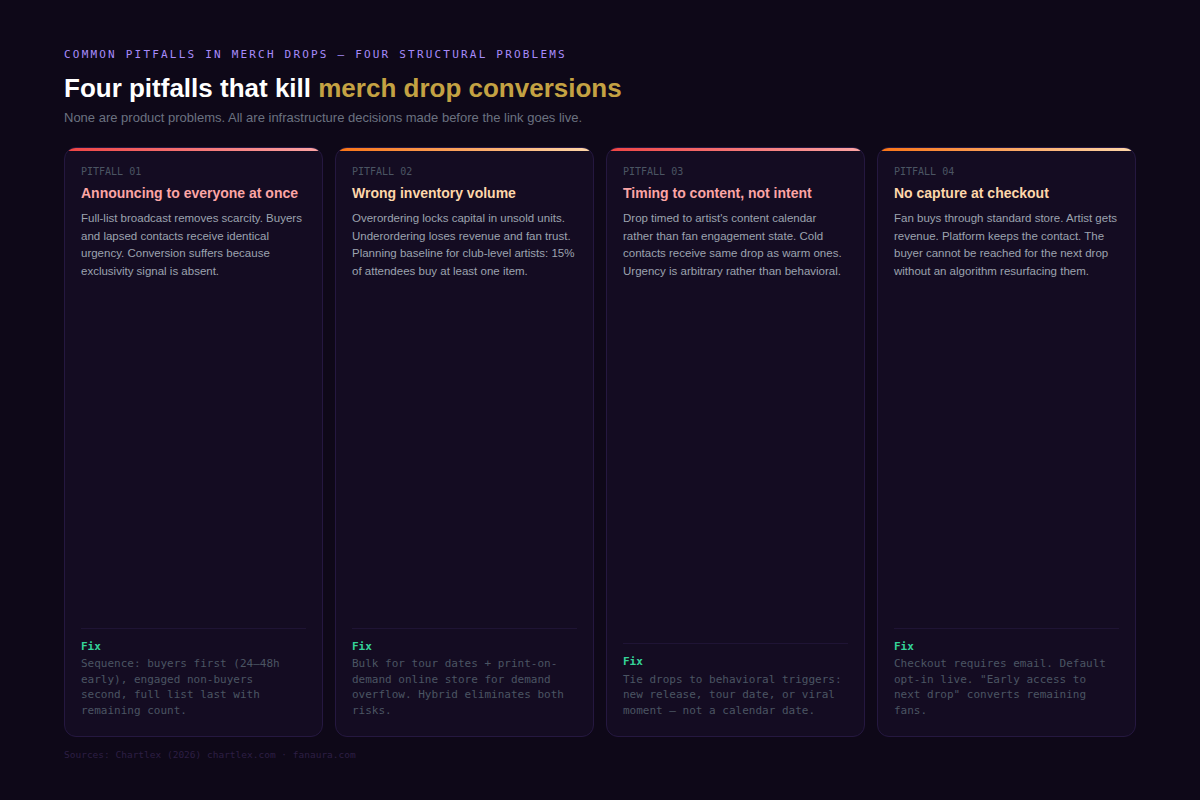
The common pitfalls in merch drops almost never come from the product itself. Artists who struggle with merch conversion are rarely selling poorly designed items at wrong prices.
They are announcing to the full list at once, timing drops to a content calendar instead of to fan intent, ordering the wrong inventory volume, and missing the fan capture opportunity at checkout.
Every one of these is a structural decision made before the link goes live, and every one of them is fixable before the next drop.
Announcing to everyone simultaneously
A merch drop sent to the full list at once is not a drop with urgency, it is a public announcement with a shorter deadline. The scarcity signal disappears when every fan receives identical access at the same moment.
Fans who would have acted on genuine early access feel the same urgency as fans who have never purchased anything. The drop converts at the lowest possible rate for both groups.
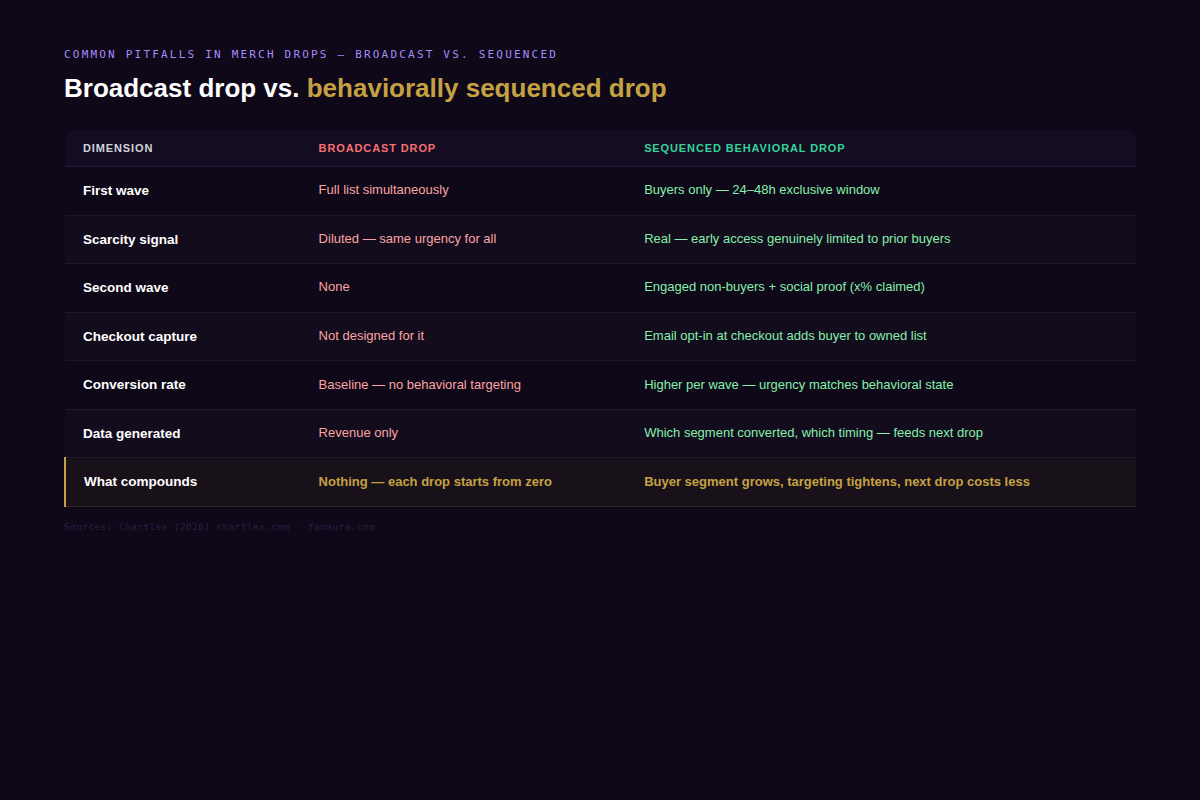
Sequenced delivery changes this entirely. Buyers - fans with at least one prior purchase - receive the drop 24 to 48 hours before any public announcement, at full price, with no discount framing. The access is real and exclusive.
Conversion from this segment outperforms any simultaneous broadcast. Engaged non-buyers receive the drop next, with a social proof signal showing how much of the limited run is already claimed.
The full list receives the final availability notice when stock is genuinely constrained. Each wave carries different urgency for a different behavioral state.
This sequence requires one thing most broadcast-style drops do not have: a CRM that distinguishes buyers from non-buyers and tracks engagement recency by segment.
Wrong inventory volume
Tour merch represents 30 to 50 percent of total touring income for independent artists at the club level (Chartlex, 2026). That number is accessible, but only with inventory planning grounded in actual conversion data.
Overordering is the most expensive mistake at this level. Unsold units represent margin lost, storage cost accumulated, and capital tied up that should fund the next release.
The planning baseline for artists playing 50 to 500 capacity shows 15 percent of attendees purchasing at least one item. Ordering to 20 to 25 percent without prior sales data to justify it is the most reliable path to excess inventory.
Underordering carries different costs. A fan who wanted to buy and could not is a less reliable buyer the next time around.
The model that solves both sides: modest bulk inventory for live dates paired with a print-on-demand online store for demand overflow. The hybrid eliminates overstock risk without capping revenue on high-demand nights.
Timing the drop to content instead of to fan intent
Most merch drops are timed to when the artist is ready to post - a content calendar date, a creative window, a convenient moment. The fan's engagement state at that moment is irrelevant to the timing decision.
A fan who has been silent for 60 days converts at a structurally lower rate than a fan who opened the last three emails and engaged with the last two social posts. Sending the drop to both at the same time wastes the urgency signal on the cold contact and misses the conversion window for the warm one.
Drops that tie to behavioral triggers convert at significantly higher rates than drops that tie to calendar dates. A new release generating strong first-week engagement is a natural drop trigger.
A tour announcement, a press placement, or a viral social moment each create elevated fan intent windows where a concurrent drop will find a warmer audience.
Missing the capture opportunity at checkout
Every merch drop is also a fan capture event. A fan who completes a purchase has crossed the conversion threshold that defines the buyer segment, the highest-value behavioral classification in any music fanbase.
A fan who buys through a standard online store and does not opt into email or SMS leaves as revenue and returns as a stranger. The artist has the transaction.
The platform has the contact. The checkout is the highest-intent opt-in moment in a merch campaign - a fan who just bought is maximally motivated to stay connected, which makes it the natural moment to add them to the owned list.
A checkout that requires email to complete the order and defaults to list opt-in captures most buyers automatically. Adding a visible opt-in with a specific offer, early access to the next drop, converts the remainder. Fans who buy once and stay connected are the ones who buy twice.
Pricing below the margin floor
Independent artists consistently underprice merch out of concern about deterring fans. The data does not support that concern at the margins most artists are working with.
A quality garment priced below $25 loses margin without meaningfully increasing conversion volume - fans who would have bought at $30 will buy at $25, but the accumulated difference across a run matters significantly.
The margin floor that makes merch operationally viable: 50 percent on every item. Items that cannot reach that threshold at realistic sales volume should not be in the lineup.
Items that consistently hit it in 2026 are tour-specific designs, vinyl with color variants, and embroidered or high-density printed apparel. Generic logo merchandise at low price points is the category most likely to sit unsold.
How Fanaura connects merch drops to fan data
Fanaura records every merch transaction as a behavioral event - updating the buyer segment automatically, tagging the purchase in the fan profile, and making that contact available for first-wave access on the next drop without manual list management.
When a drop is ready, the buyer segment is already filtered and sequenced.
Connect your merch drops to fan data with Fanaura at fanaura.com — sequence every drop correctly, capture buyers at checkout, and make each campaign more targeted than the last.
Take the next step in your music career
Build your career with a marketing team behind you.
Create your account and start planning your next release with Aura Chat.