CRM for fan management: what it actually means to manage a fan relationship
A CRM for fan management is not a contact list. It is a behavioral system that captures how fans engage, what they buy, and what drives them to act.

A CRM for fan management is not a fancy mailing list. It is the system that determines whether an artist knows their audience or just has access to them.
The difference is behavioral. A mailing list stores names and emails. A fan management CRM stores what those people did - when they pre-saved, what they bought, how they responded to a release, where they discovered the artist, and whether they came back.
Those behavioral signals are the difference between a contact and a fan you understand.
What fan management actually requires from a CRM
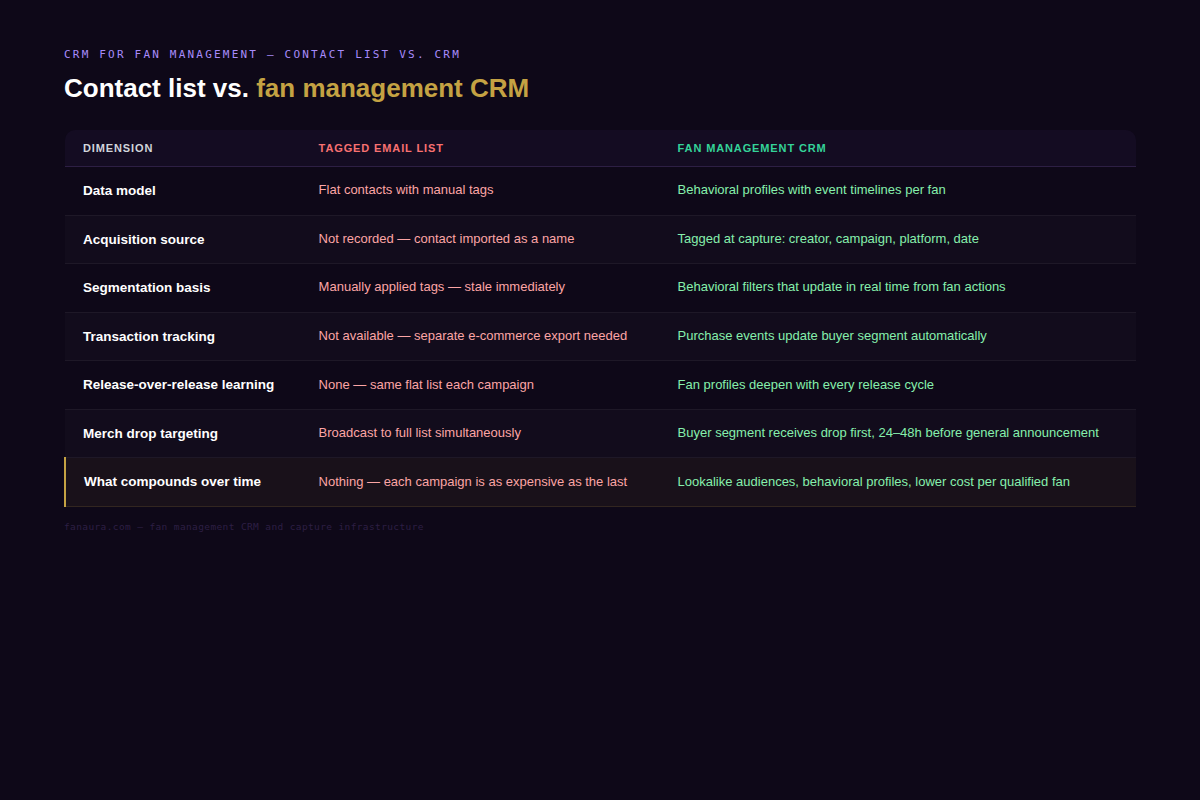
Most artists who "have a CRM" are using an email tool with tags. That is not a fan management CRM, it is a broadcast tool with segments. It sends messages.
It does not learn from responses, connect behavior across releases, or surface the intelligence that makes the next campaign more precise than the last.
A genuine CRM for fan management does four things that a tagged email list cannot:
Records the acquisition event - not just that a fan opted in, but where they came from, which campaign brought them, which creator triggered the DM, which specific release drove the pre-save. That source data predicts future behavior more reliably than any demographic filter.
Tracks behavior across time and releases - a fan who pre-saved twice, bought merch once, and opened every email for six months is not the same contact as a fan who opened one email and went quiet. The behavioral timeline is what makes a contact a fan profile.
Segments dynamically from behavior - not from manually applied tags, but from filters that reflect what fans are actively doing. Pre-savers, buyers, lapsed contacts, and acquisition-source groups each update in real time as new events occur.
Carries intelligence forward - every behavioral signal from one release feeds the targeting for the next. Lookalike audiences tighten. Cost per qualified fan drops. The CRM compounds because the data compounds.
The capture gap that undermines most fan CRM setups
A fan management CRM is only as strong as the data feeding it. And for most artists, that data is thin, not because the tool is wrong, but because the capture infrastructure upstream of the tool is missing.
A fan who discovers an artist through a TikTok and streams once never enters the CRM. A fan who pre-saves via a direct Spotify link never enters the CRM. A fan who reads a press feature and searches the name on streaming never enters the CRM.
The CRM only knows about the fans who were explicitly captured, through a landing page opt-in, a DM keyword trigger, a merch checkout with list sign-up, or a show RSVP form.
This means the quality of fan management depends less on the CRM tool than on the capture mechanisms feeding it.
A simple CRM fed by strong pre-save opt-ins, DM automation on every creator post, and a merch table sign-up generates richer fan profiles than a sophisticated CRM with no capture infrastructure behind it.
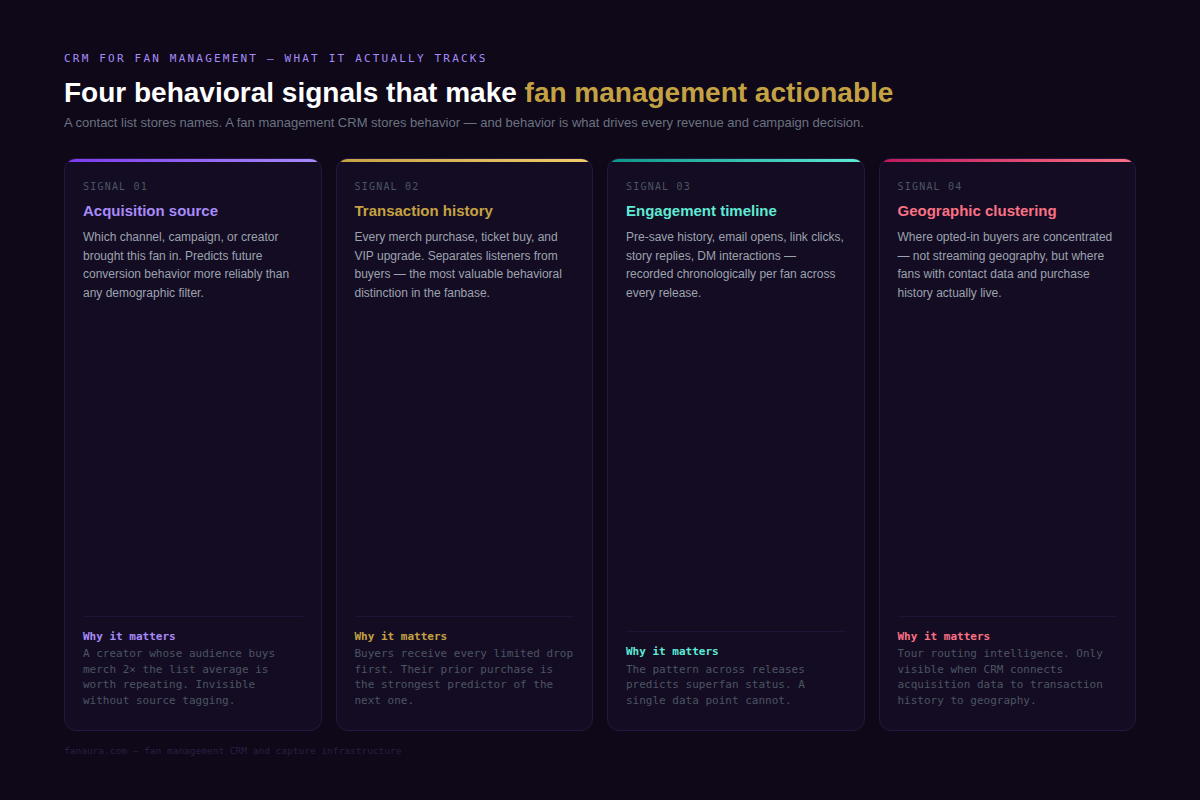
The data points that make fan management actionable
Fan management without actionable data is just contact storage. The behavioral signals that actually change what an artist does next are specific, and most CRM setups either do not capture them or capture them in ways that cannot be acted on.
Acquisition source tells you which campaigns, channels, and creators produce fans who convert, not just fans who opt in. A creator whose audience buys merch at twice the list average is worth repeating. That insight only exists if source was tagged at capture.
Transaction history separates listeners from buyers. A fan who has bought merch or a ticket has demonstrated a commitment no stream can replicate.
They are the first contact to receive every future drop, presale, and limited offering. Treating buyers the same as non-buyers wastes the relationship.
Engagement patterns across releases reveal which fans are deepening their connection and which are going dormant. A fan who pre-saved the first release, opened every email, and bought merch on the second is a superfan candidate. The pattern is more predictive than any single data point.
Geographic clustering shows where opted-in buyers are concentrated — not just where streams come from, but where fans with contact data and purchase history live. That is tour routing intelligence, not a streaming dashboard number.
How fan management data activates differently by segment
The value of a CRM for fan management is not the data itself — it is what the data enables you to say to each group, and when.
The same release announcement sent to five different behavioral segments should carry five meaningfully different framings.
Pre-savers receive the earliest notification with exclusive access. They demonstrated intent before the drop - the communication acknowledges it. Buyers receive first access to every limited offering before any public announcement.
Engaged non-buyers receive a low-friction offer designed to move them into the buyer segment. Lapsed contacts receive a re-engagement hook tied to something new. Acquisition-source segments receive messaging that references how they found the artist in the first place.
None of those messages work if the CRM cannot distinguish them. Sending the same broadcast to all five is not fan management, it is fan neglect dressed up as email marketing.
How Fanaura functions as a CRM for fan management
Fanaura is built around the gap that standard CRMs leave open - the moment between a fan encountering the music and entering the system with behavioral context attached.
Every fan who interacts with a Fanaura DM trigger, lands on a pre-save page, or completes a merch transaction enters a structured fan profile that records acquisition source, interaction history, and engagement timeline automatically.
Each subsequent touchpoint enriches the record, and segments update in real time as behavior changes.
The result is a fan management system that gets more precise with every release, not because the tool is upgraded, but because the data compounds.
Build your fan management CRM with Fanaura at fanaura.com and start turning contact data into behavioral intelligence your next release can actually use.
Take the next step in your music career
Build your career with a marketing team behind you.
Create your account and start planning your next release with Aura Chat.