CRM revenue growth: how fan behavioral data drives direct income for artists
CRM revenue growth in music comes from connecting fan behavioral data to the right offer at the right moment.

CRM revenue growth in music depends on one variable: whether the right fan receives the right offer at the moment they are most likely to spend.
Most artists send the same message to everyone on their list and measure the result by open rate.
The artists generating consistent direct revenue from their list segment by behavior first -identifying which fans have purchased before, which ones are engaged and close to converting, and which ones have gone quiet and need a re-engagement trigger before any offer reaches them.
Where CRM revenue actually comes from
Revenue generated through a music CRM follows from behavioral data quality and targeting precision. List size is a secondary variable. A well-segmented list of 800 contacts outperforms a flat broadcast list of 8,000 on every revenue event, merch drops, presales, and release-tied offers included.
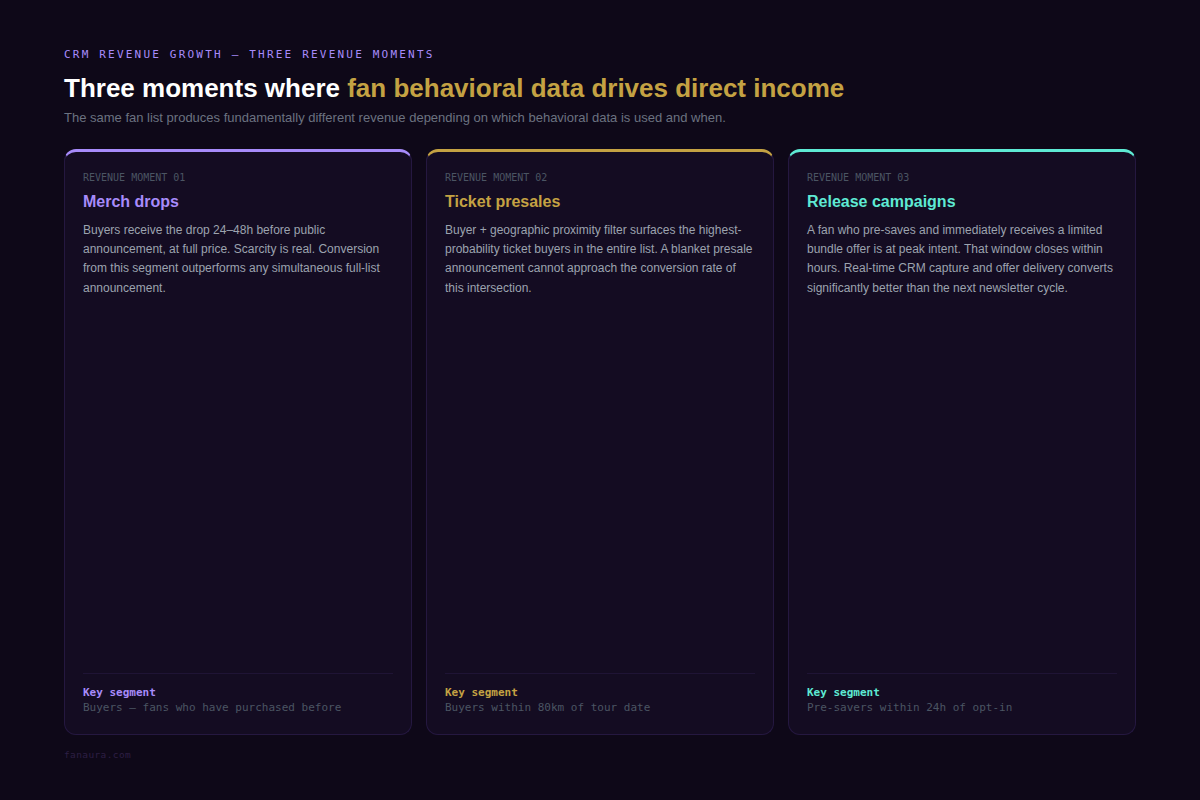
Three moments where behavioral CRM data has the highest revenue impact:
Merch drops respond directly to buyer-segment targeting. A fan who has purchased before has already demonstrated spending intent. Sending the drop to that segment 24 to 48 hours before any public announcement, at full price and without discounts, produces conversion rates that general announcements cannot replicate. The access is genuinely exclusive. The scarcity is real. The fan who receives it first feels it.
Ticket presales require a second filter layered on top of purchase history: geographic proximity. A fan who has bought merch and lives within practical travel distance of a tour date is the highest-probability ticket buyer in the entire list. Routing presale access to that intersection - buyer plus geography - turns a presale into a sellout mechanism rather than a general announcement with an earlier deadline.
Release campaigns generate revenue when the pre-save flow connects to a bundle or limited offer at the opt-in moment. A fan who pre-saves and immediately receives a limited-edition offer tied to the release is at peak intent. That window is measured in hours. A CRM that presents the offer in real time at point of opt-in converts at structurally higher rates than one that waits for the next email send cycle.
The behavioral signals that predict spending
Three signals predict conversion more reliably than any demographic data:
Transaction history is the strongest. A fan who has purchased before carries a behavioral precedent that predicts future purchases. Every limited drop, presale announcement, and bundle offer should reach buyers before any other segment.
The first-access window is not a loyalty reward, it is a targeting decision based on the probability of conversion.
Engagement recency determines whether a contact is warm or cold. A fan who opened the last three emails and clicked at least once is a warm contact. A fan who has been silent for 90 days is cold.
Sending the same offer to both groups dilutes the scarcity signal for the cold contact and wastes the urgency. Warm contacts receive the offer first, with genuine exclusivity. Cold contacts receive a re-engagement trigger first, then the offer if they re-engage.
Acquisition source predicts behavior type. Fans who entered the system through a merch checkout behave differently from fans who entered through a pre-save opt-in. The purchase history starts at the acquisition event.
A CRM that captured source data at contact creation can match offer type to fan origin, which increases conversion without requiring any change to the product or the price.
The sequencing structure that generates the most revenue per drop
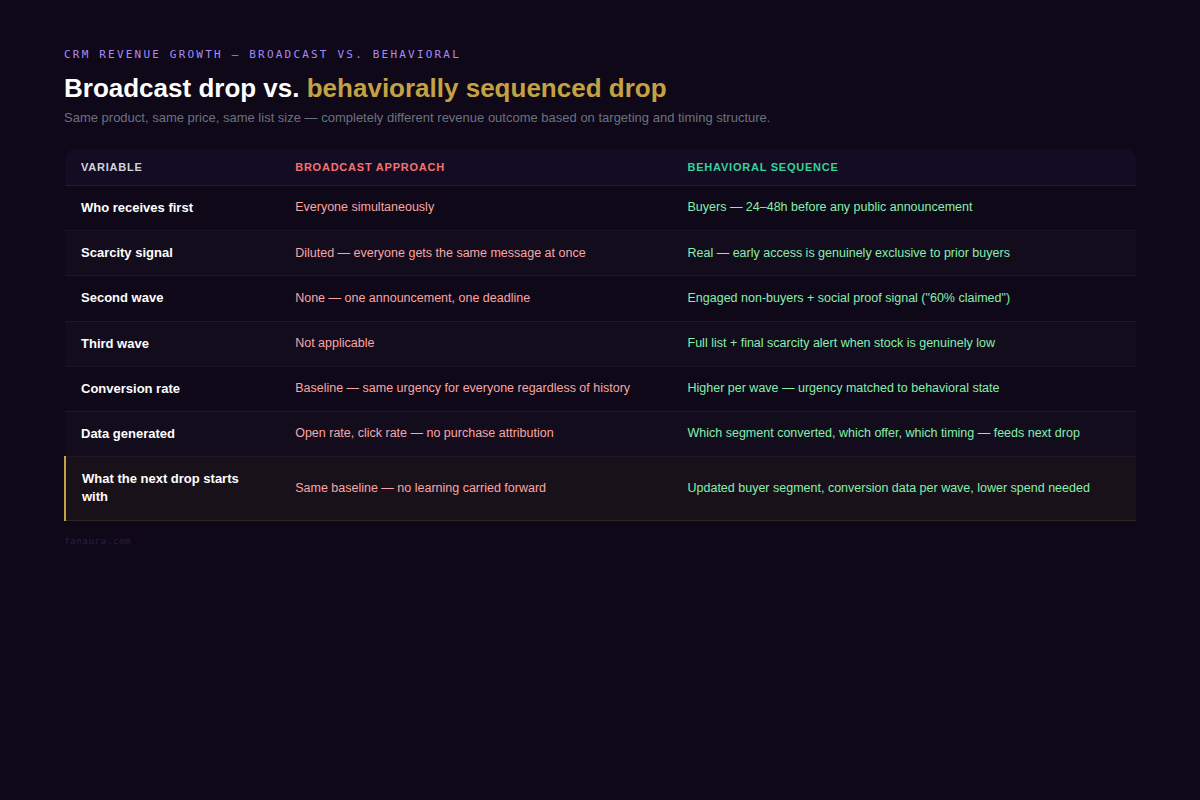
The most common CRM revenue failure is collapsing all fan segments into a single simultaneous announcement. A merch drop sent to every contact at once is a public sale, regardless of how it is framed. The scarcity signal disappears when every fan receives identical access at the same moment.
Sequenced delivery changes the structure entirely. Buyers receive the drop first, 24 to 48 hours before the announcement opens to anyone else. Engaged non-buyers receive it next, with a social proof signal showing how much of the limited run is already claimed.
The full list receives the final availability notice when stock is genuinely constrained. Each wave arrives with different urgency for a different behavioral state, which produces higher conversion across all three groups than a simultaneous broadcast would produce for any of them.
How Fanaura connects behavioral data to revenue events
Fanaura connects fan behavior to offer delivery automatically. Every pre-save opt-in, DM keyword interaction, and merch transaction updates fan profiles and segment filters in real time.
When a drop is ready, the buyer segment is already filtered. When a tour date is announced, the geographic and buyer filters are already queryable. When a release drops, the pre-saver segment is already primed for same-day outreach.
The revenue event and the behavioral data arrive at the same moment because the system connects them continuously.
Start growing CRM revenue with Fanaura at fanaura.com - connect fan behavior to offers at the moment it matters, and make every drop more precisely targeted than the last.
Take the next step in your music career
Build your career with a marketing team behind you.
Create your account and start planning your next release with Aura Chat.