Free music promotion: what actually works in 2026
Learn which free music promotion strategies drive real streams, build fan data you own, and compound across every release you drop.
Free music promotion is not about cutting corners. It is about knowing which zero-cost channels actually generate traction, investing time where it compounds, and building an audience infrastructure that grows with every release instead of resetting.
With more than 100,000 tracks landing on streaming platforms every day, visibility is no longer about volume - it is about consistency and structure.
The artists who build reach without a paid budget are not relying on luck; they are operating with repeatable systems.
The focus, then, is simple: which channels actually move the needle, which tools are worth prioritizing, and what structural gap prevents most free promotion efforts from compounding over time.
Why most free promotion efforts stall after a single release
Free music promotion works. What rarely works is free music promotion treated as a sprint.
Most artists invest heavily in the week before and after a release, then go quiet until the next one.
The channels that drive real compounding growth - blog outreach, community relationships, email lists - require consistent input across multiple release cycles, not bursts of activity around drop dates.
The underlying problem is structure. Without a system that captures what free promotion generates - listener attention, fan contact information, engagement signals - each campaign disappears the moment it ends.
A Reddit thread that drove 400 plays teaches the artist nothing if there is no mechanism to follow up with those listeners, identify who they are, or reach them again at the next release.
What separates the free strategies that compound from those that evaporate:
Channels that build owned assets: email subscribers, fan contact lists, and documented press coverage stay with the artist regardless of algorithm changes
Channels that generate data: Spotify for Artists, YouTube Analytics, and smart link data show which platforms and regions are converting, letting the artist double down on what works
Channels that earn permanent records: blog features, community reputation, and SoundCloud profiles indexed by search engines accumulate value across every release
The highest-leverage free channels, in order of return
Not every zero-cost channel deserves equal time. The distribution of effort matters more than the number of platforms an artist shows up on.
Spreading thin across eight channels typically outperforms all of them. Concentrating on three to four that match the artist's genre and output style is consistently more effective.
Spotify for Artists editorial pitching
Pitching an unreleased track to Spotify's editorial team through Spotify for Artists is completely free and represents the single highest-leverage action available to any independent artist before a release.
The pitch window opens as soon as a track is distributed and closes at release date, with a minimum of seven days required.
Effective pitches name the genre accurately, identify one mood or activity the track fits, and describe the production style without superlatives.
Editorial placement is not guaranteed - the realistic acceptance rate for independent artists without label backing sits below 5% (Dynamoi, 2026).
The pitch still matters because submitting tells Spotify's system that a release is coming, which influences how Release Radar and Discover Weekly treat it regardless of whether an editorial placement is secured.
Short-form video on TikTok and Instagram Reels
Short-form video has the highest organic discovery ceiling of any free channel.
The platforms surface content based on completion rate and save rate, not follower count - which means a new artist with zero following can reach thousands of relevant listeners with a single video that performs well.
The mechanism that drives music discovery on these platforms is simple: the first three seconds of audio determine whether someone scrolls or stops.
Content that consistently performs for music artists includes:
Studio process clips: brief, unpolished glimpses into recording sessions or vocal takes. Authenticity outperforms production value significantly in this format
Lyric breakdowns: explaining what a line means or where it came from creates emotional connection and gives the algorithm a reason to show the video to people with related interests
"Sound-off" hooks: clips where the entire visual setup makes the viewer want to unmute, putting the music's first moment of attention directly in the artist's control
The goal across all of these is consistent posting, not viral expectation. Aim for three to five posts per week and measure what stops the scroll.
Community engagement on Reddit and Discord
Genre-specific Reddit communities and Discord servers are among the most misused free promotion channels.
Artists who join to drop a link and leave consistently get ignored or banned.
Artists who spend two to three weeks genuinely participating - leaving feedback on others' tracks, answering production questions, contributing to genre discussions - build the social capital that makes a self-promotion post land positively when it eventually happens.
The rule across every community platform is identical: contribute before you ask.
The return on authentic community engagement compounds in a way that ad-driven discovery cannot replicate, because community members who become fans do so out of genuine connection, not because an algorithm showed them a paid impression.
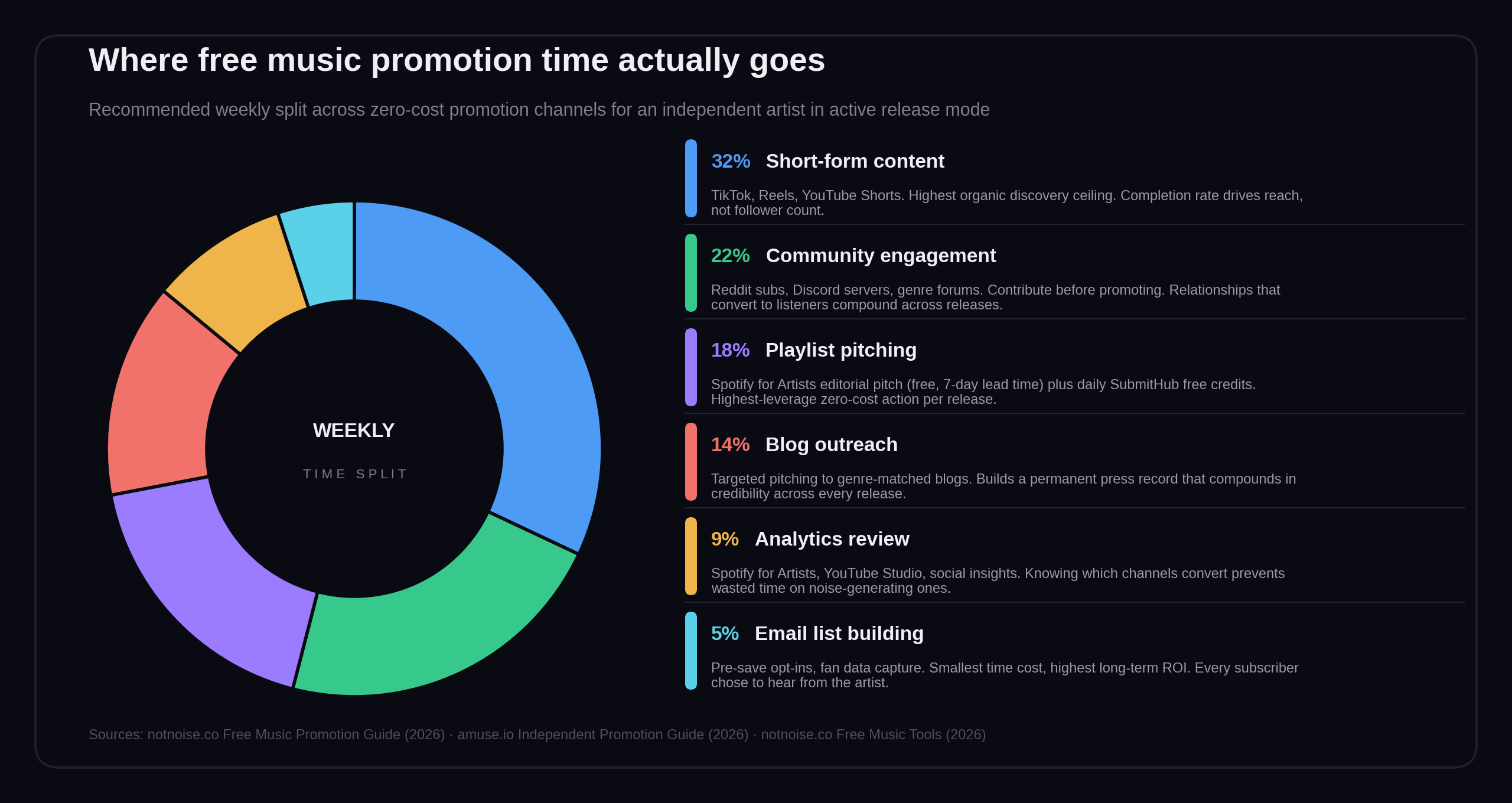
Time is the real cost of free promotion, and how it gets allocated determines the return. Most artists over-index on content creation and under-invest in the channels that build owned assets.
The chart below maps the recommended weekly split across zero-cost promotion activities for an artist in active release mode.
Free tools worth setting up before the next release
The free tool stack for an independent artist in 2026 is genuinely powerful. Several tools that previously required paid plans now offer fully functional free tiers that cover the core needs of an artist releasing singles or EPs.
Spotify for Artists
Is free and provides the most actionable analytics available: streams, listener demographics, save rate, playlist placements, and follower growth.
It is the first setup every artist should complete, and the editorial pitch tool it unlocks is the highest-leverage free promotion action in the entire toolkit.
SubmitHub's free tier
Provides a limited number of daily submission credits to blogs and playlist curators.
Used strategically - one or two targeted submissions per day to curators with a history of covering the artist's genre - the free tier can drive meaningful placements over a consistent three-to-four-week campaign around a release.
Canva's free plan
Covers album artwork, social graphics, and promotional templates at professional quality.
Visual consistency across streaming profiles and social platforms is a credibility signal that affects how new listeners perceive the artist before a single note plays.
SoundCloud's free upload tier
Maintains relevance for artists in electronic, lo-fi, and bedroom pop adjacent genres, where the platform's community of active listeners still drives genuine discovery.
Tags and complete metadata are what determine whether a track surfaces in SoundCloud's organic recommendation system.
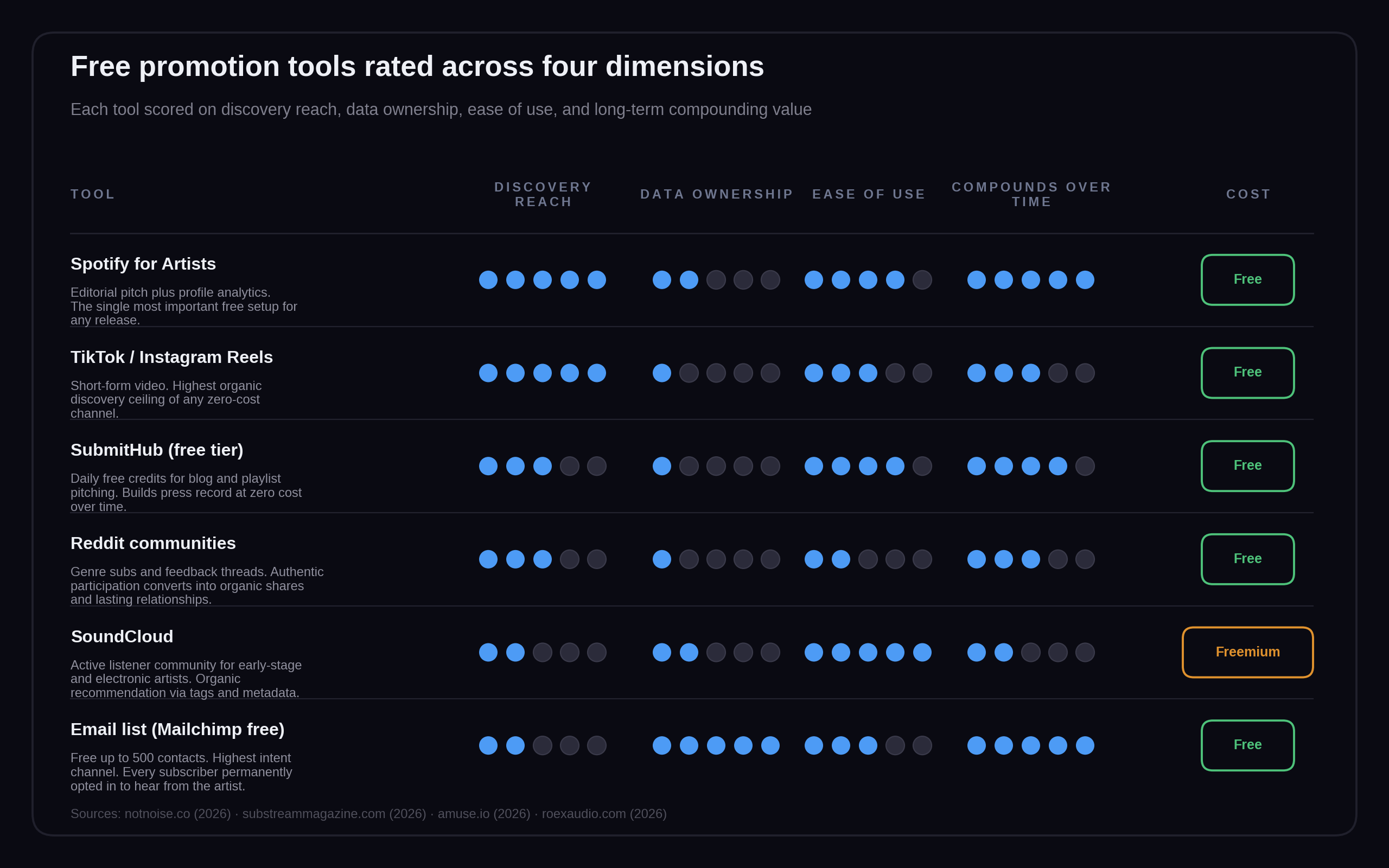
Not every free tool delivers equally across reach, data ownership, ease of use, and long-term compounding value.
The scorecard below rates the core free tools across all four dimensions so the investment of time goes where it actually returns.
The gap free promotion cannot close on its own
Free music promotion is real, and it works. What it does not do on its own is convert attention into something the artist keeps.
A TikTok video that drives 80,000 views teaches the algorithm something useful, but it does not tell the artist who those viewers are, where they live, or how to reach them before the next release.
A Spotify editorial pitch that lands on Release Radar drives streams, but those listeners remain on Spotify's terms.
The structural gap is fan data ownership. Every free channel generates reach that lives inside someone else's platform.
The artists who transform free promotion into compounding returns are the ones who build a mechanism - a pre-save opt-in, a keyword DM trigger, a fan list - that captures real contact information from the listeners that free channels surface.
Several actions close this gap at no additional cost:
A pre-save page with an email opt-in captures contact information from fans who arrive via free channels before the track goes live, converting temporary attention into a permanent subscriber
A keyword trigger via Instagram DM routes fans from Reels content into a system that captures their profile and builds a contact record the artist owns
A smart link with analytics attached to every free channel post shows which channels are converting and which are generating noise, so the next release starts with better information
Fanaura is built to add this capture layer to whatever free promotion is already working.
Fan data from every touchpoint - organic posts, blog features, pre-save links - flows into one system that builds profiles the artist controls entirely. Free channels earn the reach.
The system makes it last. If that infrastructure is missing from the current setup, Fanaura is worth a look.
Take the next step in your music career
Build your career with a marketing team behind you.
Create your account and start planning your next release with Aura Chat.