How to advertise music that actually reaches the right fans
Discover the best way to advertise music, build fan data you own, and run campaigns that compound across every release.

The best way to advertise music is not a single channel - it is a coordinated sequence that turns first-time listeners into long-term fans.
Over 120,000 tracks are uploaded to Spotify every day (Cyber PR Music, 2026), and visibility is not something any artist can leave to chance.
The real question is not whether to promote, but where to invest, in what order, and how to make each campaign smarter than the last.
Why music advertising fails before it even starts
Most artists treat advertising as a final step, something activated the day a song drops. That timing makes every dollar harder to spend.
Without pre-release momentum, ad platforms have no behavioral data to optimize against, and the release window closes before organic discovery even catches up.
The teams that see consistent returns on music promotion treat advertising as the middle layer of a three-phase cycle: build, launch, and enrich.
Each phase feeds the next. Understanding that sequence is the actual foundation of a launch that compounds over time.
The most damaging structural mistakes:
Skipping the pre-release window: launching without pre-saves removes the day-one intent signals that lift algorithmic placement on release day
Sending traffic directly to Spotify: bypassing a landing page eliminates the pixel data needed to retarget and segment audiences in future campaigns
Abandoning a release after five days: a song with steady week-two and week-three promotion consistently outperforms one with a launch-day spike and no follow-through
Treating every channel as independent: when ads, playlists, and email do not reinforce each other, the cumulative effect drops significantly
Meta ads: the most controllable paid channel for music
Meta advertising through Instagram and Facebook remains the most reliable paid channel for growing a fanbase from scratch in 2026.
The core reason is control: artists can target by genre affinity, geography, and lookalike audiences built from existing fan data, then optimize spend toward the segments that actually convert.
The structure that consistently works routes ad traffic to a smart link landing page rather than directly to Spotify.
The landing page fires a Pixel conversion event when a fan clicks through to stream - giving the algorithm a confirmed intent signal, not just a click.
Video ads average significantly lower cost-per-save than image formats and generate stronger optimization signals (Dynamoi, 2026).
Key decisions within a Meta campaign:
Optimize for conversions, not reach: reach campaigns inflate impressions but rarely drive the saves and follows that matter for streaming algorithmic placement
Run at least three creative variations: each featuring a different section of the track, so the algorithm identifies which hook resonates with which audience segment
Exclude high-bot-activity countries: without geographic filters, Meta optimizes toward cheap clicks, not real streams
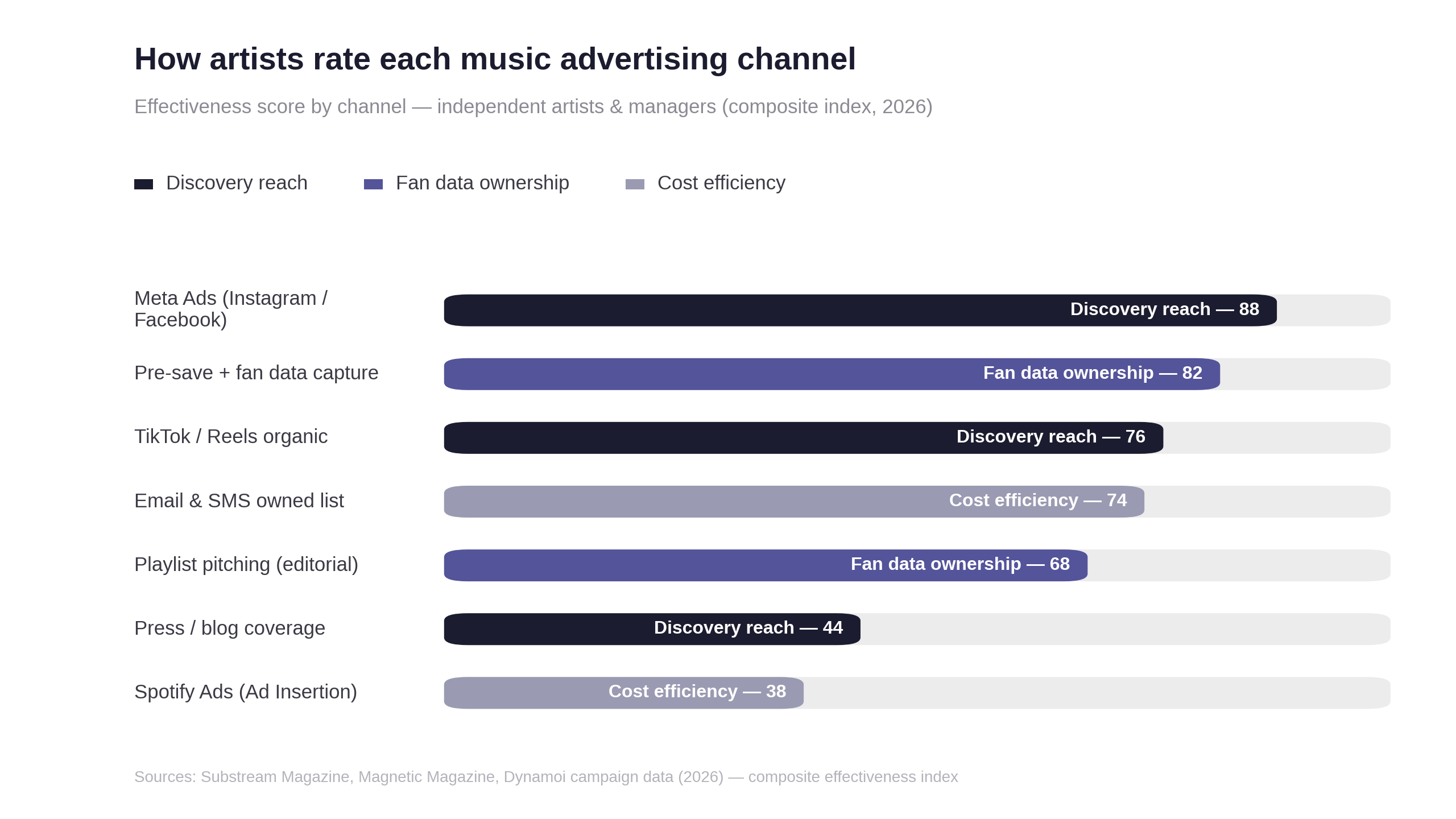
Which advertising channel performs best depends on what an artist needs at each stage. Discovery reach, fan data ownership, and cost efficiency each favor different tools.
Understanding those trade-offs helps teams allocate budgets across a full release cycle instead of defaulting to a single channel.
Pre-saves and fan data: the asset most artists give away
Running ads without capturing fan data is the most common and costly structural gap in music advertising.
When a fan saves a track through a generic pre-save link, the streaming platform captures their identity - the artist captures nothing. That fan becomes invisible the moment the campaign ends.
The smarter structure captures contact information at the moment of highest intent, which is always the pre-release window.
A fan who opts in with their email or phone number is demonstrating real interest. That contact is an audience asset the artist fully controls regardless of what any platform algorithm decides next cycle.
Fanaura's pre-release flow is built around this logic. A fan interacts with a keyword trigger via Instagram DM or SMS, the system captures their data in a structured fan profile, and every subsequent touchpoint enriches that record.
By launch day, the team knows who those fans are, where they live, and what they're most likely to buy - merch, tickets, or the next release.
That is first-party fan intelligence, and it compounds with every launch.
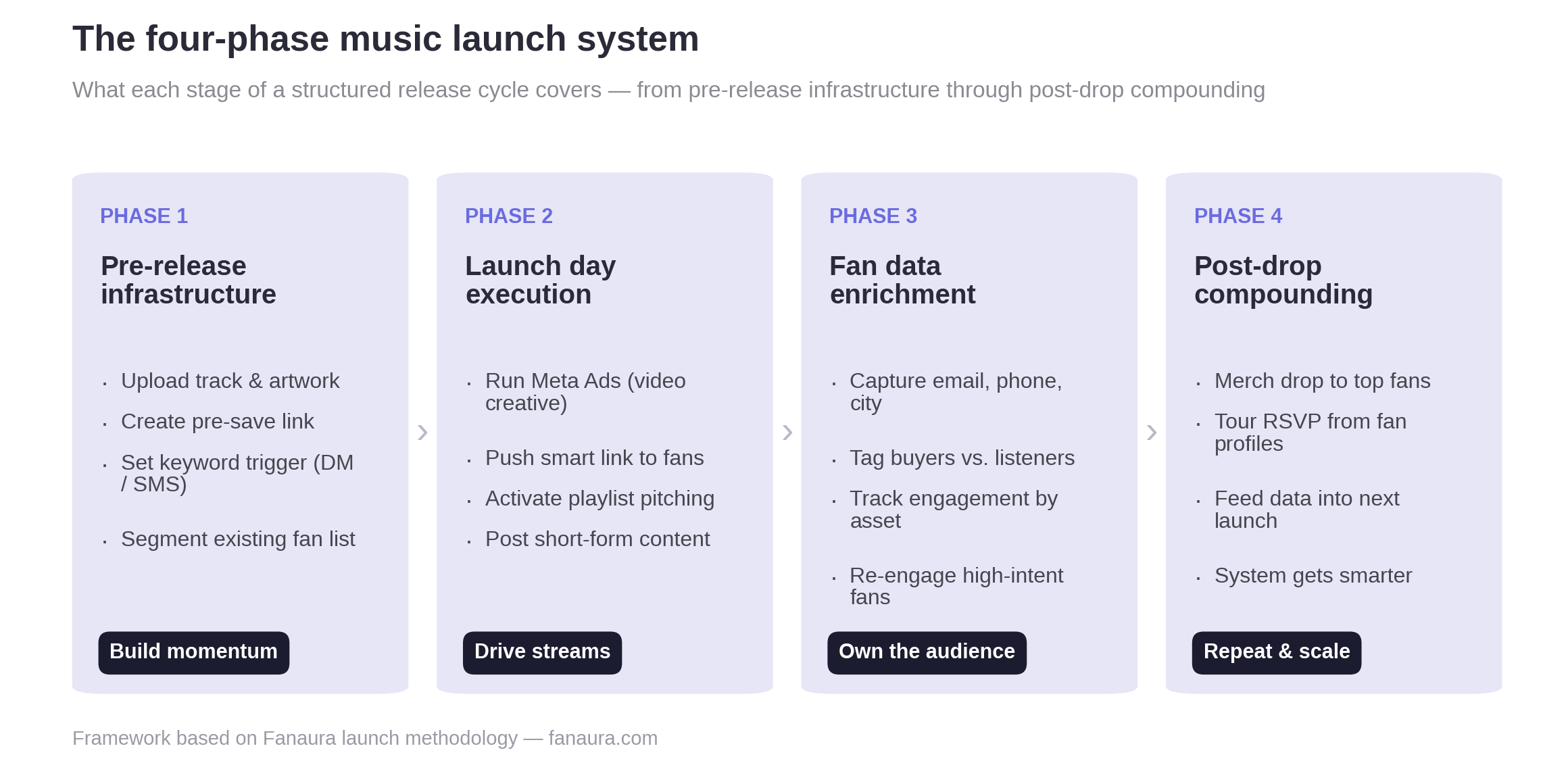
Most releases fail not because the music is weak, but because there is no system connecting the phases.
Mapping this flow before a campaign begins determines whether each release builds toward the next or resets.
Owned channels: what holds when algorithms shift
Email and SMS have one irreplaceable quality in a music advertising strategy: reach does not depend on platform decisions.
When Instagram changes its organic distribution or Spotify shifts algorithmic weighting, an owned list operates entirely independently of those changes.
According to TuneBlast (2026), a fan list of 500 high-intent subscribers consistently outperforms a social following of 10,000 passive ones. Intent is the difference.
A subscriber opted in, which means their attention is not competing with thousands of other posts for visibility.
Channel sequencing that works:
Email for context and announcements: release dates, merch drops, tour routing, and exclusive content land well because the reader is in a low-distraction environment that favors longer formats
SMS for time-sensitive triggers: presale alerts and day-of-show reminders carry dramatically higher open rates than any other channel; they are the best tool for converting high-intent fans into ticket and merch buyers
DM automation for fan interaction: keyword-triggered flows on Instagram let artists engage fans at scale without losing the personal feel that drives loyalty over time
Building that list is a direct function of structured fan capture at the pre-release stage.
Every keyword interaction, every pre-save opt-in, and every merch transaction is an opportunity to add a verified contact to the artist's direct communication infrastructure.
A release system that compounds with every launch
The artists and teams that see compounding returns from music advertising are not necessarily spending more, they are spending better because each release teaches the system something the previous one could not.
Fan profiles grow richer, lookalike audiences tighten, and the gap between a campaign launch and real streaming impact narrows with every cycle.
That effect requires infrastructure, not just effort. Without a single source of truth connecting music assets, fan data, and outbound communication, each release starts from scratch.
Fanaura connects those layers, linking music launches, merch drops, and tour campaigns into one system where every fan action sharpens the next launch automatically.
If the current approach resets with every release, the right move is to build the system that stops that from happening.
Take the next step in your music career
Build your career with a marketing team behind you.
Create your account and start planning your next release with Aura Chat.