How to get more Spotify listeners: the signals that actually drive algorithmic growth
Getting more Spotify listeners is a consequence of the right fan behavior, not volume of promotion. Understand the signals that drive algorithmic growth, and how to build them before release day.
How to get more Spotify listeners is one of the most searched questions in independent music, and most of the answers focus on the wrong metric.
Streams are visible. Monthly listeners are trackable. Both feel like the goal. But the Spotify algorithm in 2026 does not weight all streams equally.
A passive listen through a playlist that the fan never revisits is worth far less than a save, a replay, or a manual add to a personal playlist. The artists building sustainable listener growth are optimizing for behavior, not volume.
How to get more Spotify listeners: what the algorithm actually responds to
The core mechanic is straightforward. Spotify rewards engagement signals - saves, completions, replays, profile visits, and manual playlist adds - because those signals prove that a listener is connecting with the music, not just scrolling past it.
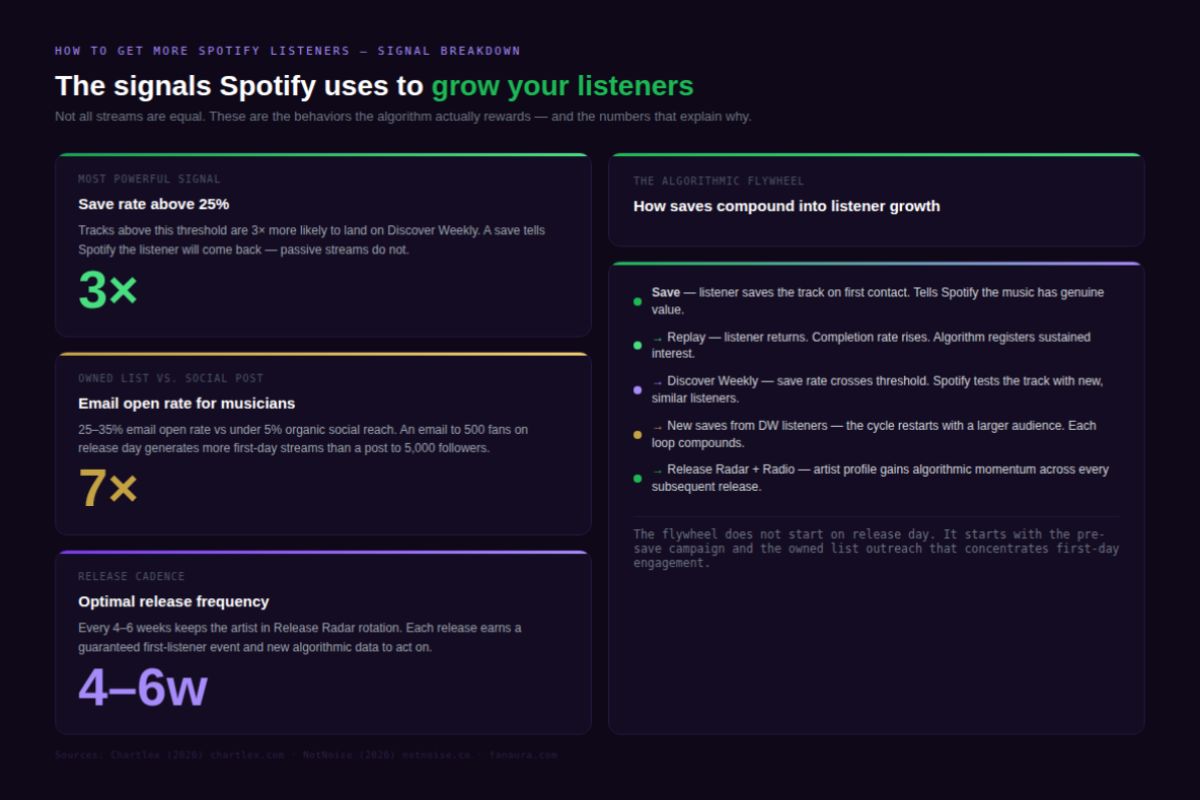
The save rate is the most powerful of those signals. Tracks with a save rate above 25% are three times more likely to land on Discover Weekly within the first month of release compared to tracks with a save rate under 10% (Chartlex, 2026).
Discover Weekly is the highest-value placement on the platform - it delivers the right track to listeners who have never heard the artist but are statistically likely to save it.
The implication for promotion strategy is significant. Asking fans to save a track is more algorithmically valuable than asking them to stream it.
"Save this song" as a call to action on social content feeds the algorithmic flywheel more directly than "stream my new single." One behavior tells Spotify the track has genuine value. The other generates a number.
Not all listeners convert equally. A listener who found the artist by typing their name into the search bar saves at a dramatically higher rate than one who heard the track passively in a playlist. Intent-driven discovery - through short-form video, through owned list outreach on release day, through pre-save campaigns - produces the listeners who actually move the algorithm.
The pre-release window: where listener growth is decided before the track drops
The first 48 to 72 hours after a release are when Spotify makes its initial algorithmic judgment.
If engagement in that window is strong - high save rate, high completion rate, meaningful replay - the platform begins testing the track in Discover Weekly and Release Radar for a wider audience.
If engagement is weak, the track enters the system quietly and accumulates low-engagement streams that dilute the save rate before the core audience even finds it.
That window cannot be built on release day. It has to be built before it.
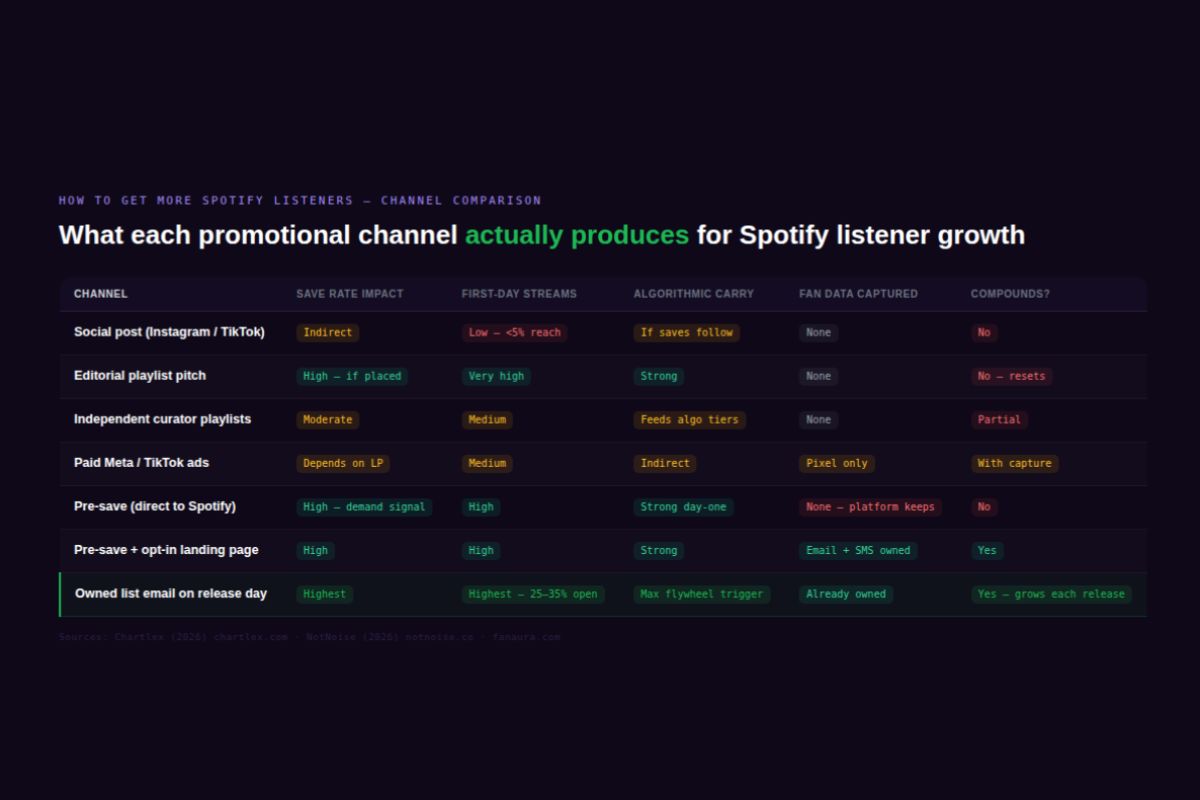
A pre-save campaign that routes fans to a landing page rather than directly to Spotify does two things simultaneously: it registers demand before the track drops, and it captures the fan's contact information - email or phone - so they can receive direct outreach the moment the track goes live.
An email to 500 genuine fans on release day generates more first-day streams than a post to 5,000 Instagram followers.
Email open rates for musicians average 25 to 35 percent, while social media organic reach sits under 5 percent (NotNoise, 2026).
The owned list is the most reliable mechanism for producing the concentrated first-day engagement that Spotify's algorithm interprets as a signal worth amplifying.
Playlist pitching: the three tiers and how each feeds the next
Playlist placement remains one of the most effective ways to reach new listeners on Spotify - but the three playlist tiers operate differently, and most artists pitch to the wrong one first.
Editorial playlists - New Music Friday, RapCaviar, Mood Booster - are curated by Spotify's in-house editors. A placement delivers millions of streams, but the only entry point is a pitch submitted through Spotify for Artists at least four weeks before release.
There are no exceptions. A track that drops without an editorial submission has no chance at that tier regardless of how strong it performs.
Algorithmic playlists - Discover Weekly, Release Radar, Radio - cannot be pitched directly. They are earned through engagement signals.
A strong save rate, high completion rate, and genuine replay behavior tell Spotify the track belongs in front of listeners who do not yet know the artist.
Every other strategy on this list feeds into algorithmic placement indirectly. This is the most scalable tier: once triggered, it compounds without additional spend.
Independent curator playlists are the most accessible starting point for most independent artists.
A playlist with 5,000 active, engaged listeners outperforms one with 50,000 inactive ones - because genuine listeners save and replay, generating the engagement signals that feed the algorithm.
Personalised pitches of three to five sentences, referencing a specific track already in the playlist, sent two weeks before release, with a clean Spotify link and no attachments: that format converts. Generic copy-paste pitches do not.
Release cadence: how often to release and why it compounds
Releasing every four to six weeks is the structural frequency that most independent artists consistently report as the sweet spot for algorithmic visibility.
Each new release earns a slot in Release Radar - delivered to everyone who has followed the artist or listened recently.
More releases mean more guaranteed first-listener events. More first-listener events mean more behavioral data for the algorithm to act on.
The compounding mechanism is the reason waterfall sequencing outperforms single album drops for listener growth.
Each release in a sequence builds on the behavioral signals the previous one generated. Lookalike audiences tighten.
Discover Weekly placements become more frequent. The gap between release day and meaningful algorithmic carry narrows with each successive drop.
Singles outperform albums for discovery at this stage. Each single gets its own Release Radar cycle, its own editorial submission window, and its own opportunity to generate a concentrated engagement signal.
An album releases all of that simultaneously and receives one evaluation window for all of it.
What most artists miss: the fan layer that multiplies every Spotify strategy
Every strategy above becomes more effective when there is an owned fan list behind it.
Short-form video drives discovery - but a fan who discovers the artist on TikTok and then receives a pre-save prompt via Instagram DM automation is exponentially more likely to save the track than one who finds the bio link on their own.
The DM captures intent at its peak and routes it toward the exact behavior the algorithm rewards.
Press coverage earns credibility - but a fan who reads a blog feature and then receives a direct email on release day converts at
a structurally different rate than one who has to remember to search for the artist later. The owned list is the bridge between every external promotional channel and the concentrated first-day engagement that moves the algorithm.
Pre-save campaigns register demand - but a pre-save that captures an email or phone number before routing to Spotify turns a one-time interaction into a permanent owned contact.
That contact receives outreach on release day, on the merch drop, on the next pre-save - compounding across every subsequent release.
How Fanaura connects listener growth to the full release system
Growing Spotify listeners is not a Spotify problem. It is a fan behavior problem - and the solution is infrastructure that produces the right behavior at the right moment in every release cycle.
Fanaura connects every layer of that infrastructure:
Pre-save flows with opt-in capture - fan contacts collected before streaming platforms absorb the relationship, routed toward day-one owned-list outreach that concentrates first-day engagement
Instagram DM automation - keyword-triggered flows that capture fan contact and route toward the pre-save landing page at the moment of highest intent
Owned email and SMS lists - the mechanism that converts external discovery into concentrated day-one streams and the save-rate signals Spotify acts on
Behavioral data across releases - save patterns, engagement history, and geographic signals feeding back into targeting for the next drop, tightening the audience that produces the next round of algorithmic carry
Access Fanaura at fanaura.com - build the fan infrastructure that turns every Spotify release into a compounding system of listener growth.
Take the next step in your music career
Build your career with a marketing team behind you.
Create your account and start planning your next release with Aura Chat.