Management tools for artists: the four operational layers and what most stacks get wrong
Management tools for artists cover coordination, analytics, and revenue. The fan data layer most stacks leave out is where career momentum compounds.

Management tools for artists have multiplied to the point where the relevant question is no longer whether to use them.
It is which operational problems each layer solves, in what order to build the stack, and which gaps require dedicated infrastructure rather than a general-purpose tool stretched past its design.
The artists with the clearest operational picture tend to run fewer tools than average - chosen deliberately, each covering a specific layer, none doing a job it was not designed for.
The four operational layers artists need to cover
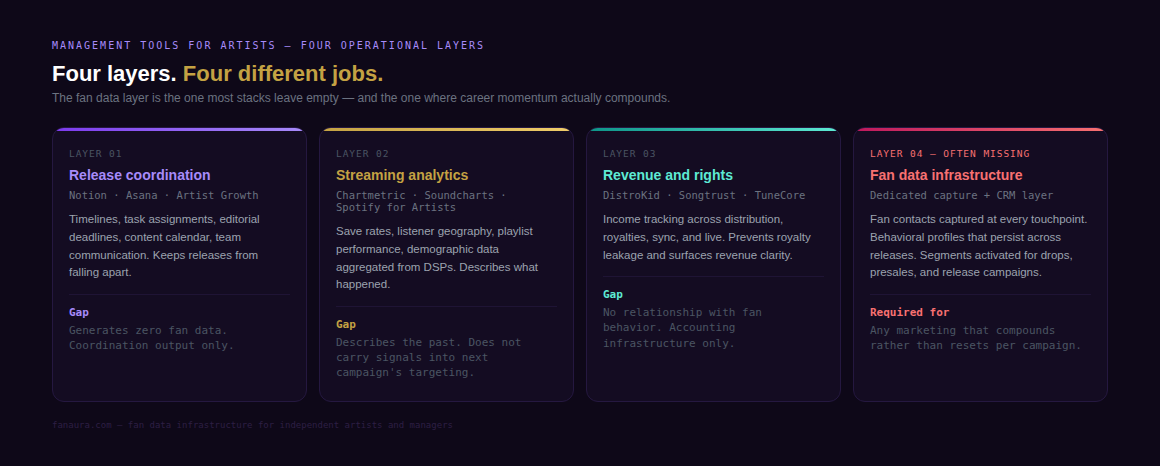
Release coordination is the scheduling and task layer. It handles timelines built backward from release dates, editorial submission deadlines, content calendar planning, team task assignments, and communication between the artist, manager, and external partners.
General project management tools like Notion or Asana can cover this when adapted for music workflows; music-specific platforms like Artist Growth add industry-relevant templates.
What this layer does well: keeps releases from falling apart. What it does not do: generate or retain any fan data.
Streaming and social analytics is the dashboard layer. It aggregates data from Spotify for Artists, Apple Music Analytics, YouTube Studio, and social platform insights into unified views that surface save rates, listener geography, playlist performance, and demographic patterns.
Chartmetric and Soundcharts serve parts of this function. What this layer does well: describe what already happened. What it does not do: carry behavioral signals forward into the next campaign's targeting.
Revenue and rights management tracks income across distribution, performance royalties, sync licensing, and live. DistroKid, TuneCore, and Songtrust each cover parts of this layer.
What it does well: prevent royalty leakage and surface income stream clarity. What it does not do: have any relationship with fan behavior.
Fan data and relationship management is the layer most stacks leave empty, and the one where career momentum either accumulates or resets.
It requires capturing fan contacts at every pre-release touchpoint, building behavioral profiles that persist across releases, segmenting by purchase history and engagement recency, and using those segments to drive release-day outreach, merch drops, and presales.
No general-purpose scheduling or analytics tool does this. It requires dedicated fan capture infrastructure.
How to add tools in the right order
The mistake most artists make is evaluating tools by feature count rather than by operational stage fit.
A tool that solves the right problem for the current career stage is valuable. A tool that solves a problem that does not yet exist wastes both the cost and the time to operate it.
The sequence that produces the least wasted spend:
Start with release coordination. A shared document or simple project management tool handles this at early stage. No spend required.
Add streaming analytics once releases are consistent. Understanding which markets are growing and which channels are generating engagement is essential for allocating promotional spend.
Build fan capture infrastructure once there is a promotional operation. Pre-save opt-ins, DM automation, and merch checkout with list sign-up belong here. This is the gap that most stacks never fill.
Add behavioral segmentation once the list has enough history to segment meaningfully. Tools that activate segments for drops, presales, and release campaigns generate the highest return on any tool investment in the stack.
Adding analytics before consistent releases, or CRM infrastructure before contacts exist to populate it, wastes the tool and the time. The stage determines the tool.
The gap between analytics and action
Most management tools for artists are strong in the space between "something happened" and "here is the data about it."
They are structurally weaker in the space between "here is the data" and "here is what to do with it next."
A streaming analytics tool surfaces a save rate spike in a specific geographic market. The tool shows the spike.
It does not identify the fans who caused it, surface their contact details, or route them into a presale segment when a tour date in that market is confirmed.
A social analytics tool surfaces high engagement on a specific post. The tool shows the engagement. It does not capture the fans who engaged, connect them to a DM opt-in flow, or add them to a behavioral profile the next campaign can target.
The data exists in both cases. The capture and routing infrastructure does not. Closing that gap requires a layer separate from the analytics tools - one that receives events from every channel and accumulates them into a fan profile the artist controls.
Where Fanaura fits in the management stack
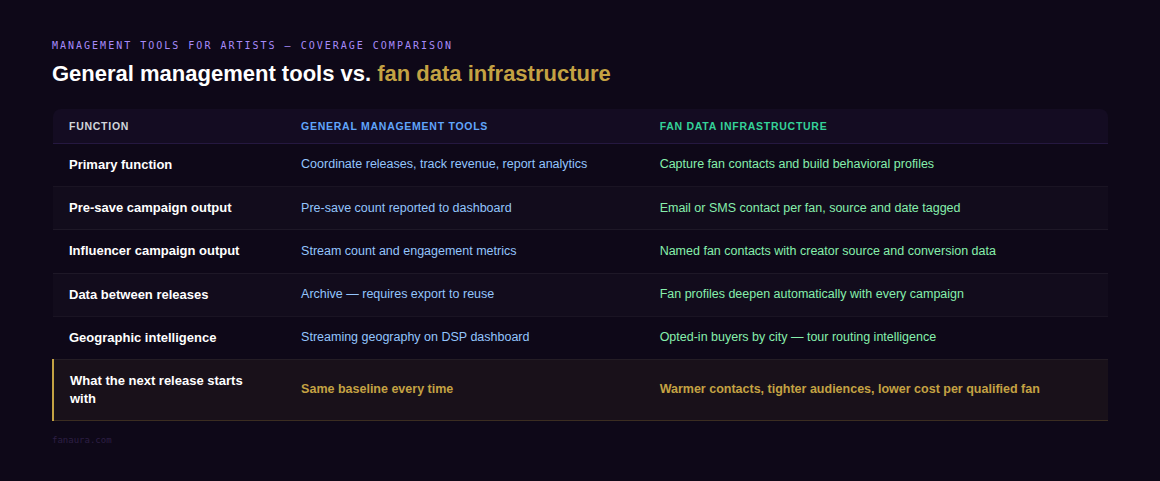
Fanaura is the fan data layer that most management tool stacks leave out — the infrastructure that captures what every channel generates and routes it into behavioral fan profiles that compound across releases.
Pre-save campaigns generate owned contacts instead of just pre-save counts reported to a dashboard
DM automation on social posts converts engagement into email and SMS contacts, source-tagged automatically
Merch transactions update the buyer segment in real time, available for first-wave targeting on the next drop
Geographic and behavioral filters built from every prior campaign are queryable the moment a new tour date or release is confirmed
Add the fan data layer to your management stack with Fanaura at fanaura.com - and make sure what your coordination and analytics tools produce actually converts into something you own.
Take the next step in your music career
Build your career with a marketing team behind you.
Create your account and start planning your next release with Aura Chat.