Music artist marketing: what actually builds a career in 2026
Understand what music artist marketing actually requires in 2026: from content strategy and streaming discovery to fan data and release systems that compound.

Music artist marketing is the system an artist builds to turn discovery into sustained audience growth, release after release.
Over 120,000 tracks reach streaming platforms every day, according to mngrs.ai's 2026 music marketing analysis. Visibility is no longer the natural outcome of releasing good music.
It is the result of deliberate decisions made before, during, and after every launch. The artists who build real careers in this environment are not the ones with the largest budgets.
They are the ones who treat each release as one chapter in a longer system.
What music artist marketing actually means today
Music artist marketing determines whether a release reaches new listeners - and whether those listeners become fans the artist can reach again.
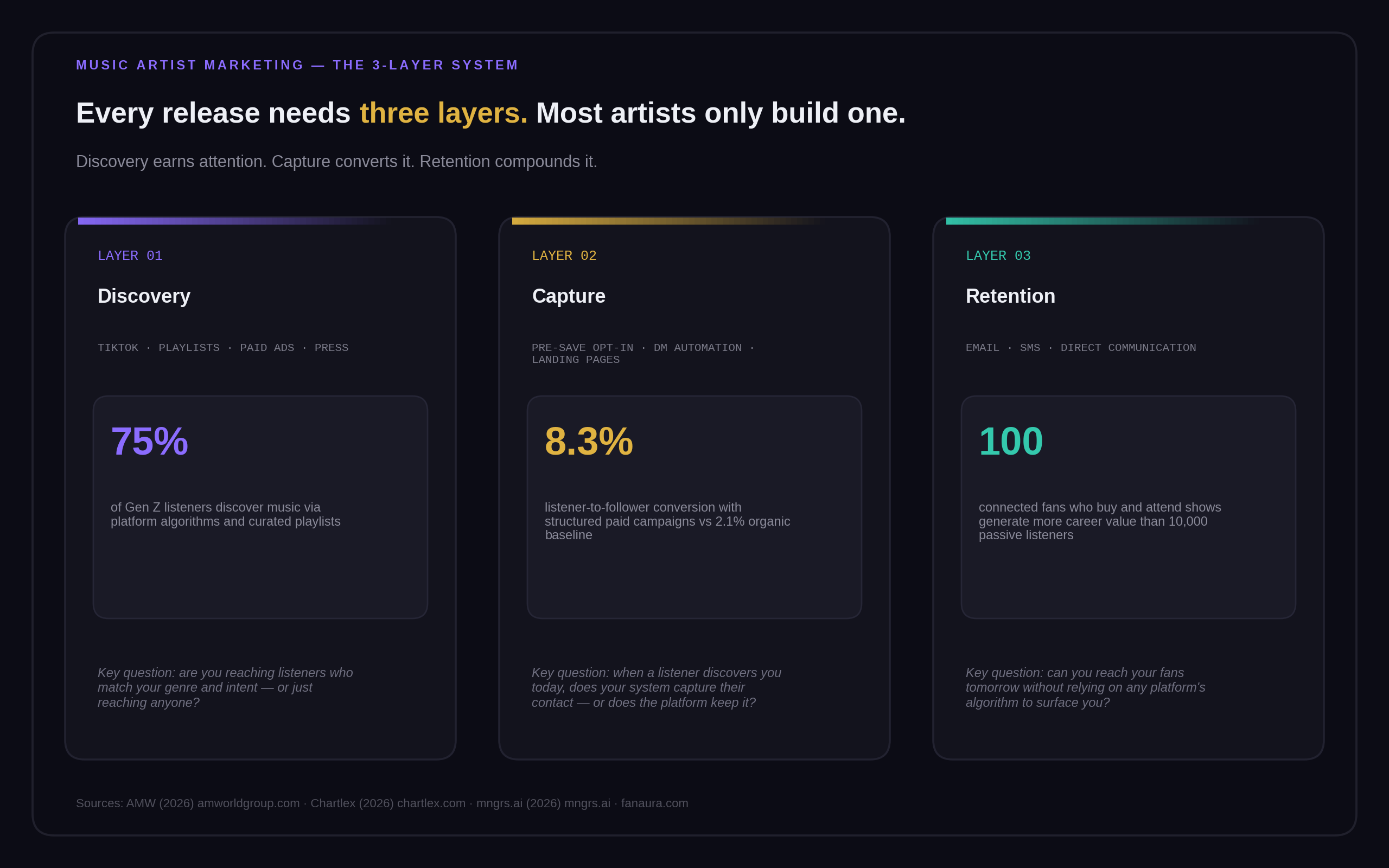
The distinction matters more than most teams realize. According to mngrs.ai's analysis, 100 genuinely connected fans who attend shows and buy merch create more long-term career value than 10,000 passive streams from listeners who cannot recall an artist's name a week later.
The goal is not stream accumulation. It is audience ownership - a group of people the artist can reach directly, without depending on any platform's algorithm.
Independent artists now hold over 40 percent of total global recorded music market share, according to Orphiq's 2026 music industry report.
That share was built not by artists who outspent major labels. It was built by artists who out-systematized them: releasing consistently, capturing fan data, and carrying what they learned from each campaign into the next one.
The three layers every artist marketing strategy needs
Before investing in any specific channel, it helps to map what a complete music artist marketing strategy actually covers.
Most artists focus on the first layer and skip the other two entirely.
The discovery layer is what most people mean by "music promotion." It includes short-form video on TikTok and Instagram Reels, paid advertising, playlist pitching, press outreach, and algorithmic surface on streaming platforms.
According to AMW's 2026 streaming statistics, 75 percent of Gen Z listeners discover new music through platform algorithms and curated playlists. Discovery earns attention. It is necessary, but not sufficient on its own.
The capture layer is where most music artist marketing breaks down. Discovery without capture means every campaign starts from scratch.
When a listener finds an artist through a playlist or a TikTok, that attention lives on the platform that surfaced it. The artist captures nothing.
A capture layer - pre-save flows with email or SMS opt-ins, keyword-triggered DM automation, landing pages with pixel conversion events - turns that attention into a contact the artist controls.
The retention layer is what converts a contact into a fan and a fan into a buyer. Email lists, SMS lists, and DM sequences operate independently of any platform algorithm.
According to Chartlex's 2026 industry analysis, paid promotion lifts listener-to-follower conversion to 8.3 percent against a 2.1 percent organic baseline - but only when the campaign sends traffic somewhere that captures intent, not just streams.
Short-form video is now the front door to every release
Short-form video has become the primary gateway between an artist and a new listener.
According to Sprout Social's 2026 social media data, short-form video delivers the highest ROI (return on investment) of any social media content format, cited by 41 percent of marketers.
TikTok, Instagram Reels, and YouTube Shorts are not simply promotional channels. They are the surface where a stranger decides whether to become a listener.
The structural implication is significant. An artist who treats a release as a one-day announcement competes against artists who treat the same release as four to eight weeks of content.
Studio footage, lyric breakdowns, process videos, and behind-the-scenes moments each create a new opportunity for the algorithm to surface the track to someone who has never heard it. In this sense, the content is not separate from the marketing - it is the marketing.
Beyond that, the artists building momentum in 2026 are not posting more. They are batching more deliberately: one release generates twenty to thirty pieces of short-form content, each targeting a different hook angle for a different segment of potential listeners.
Why a release system beats a release campaign
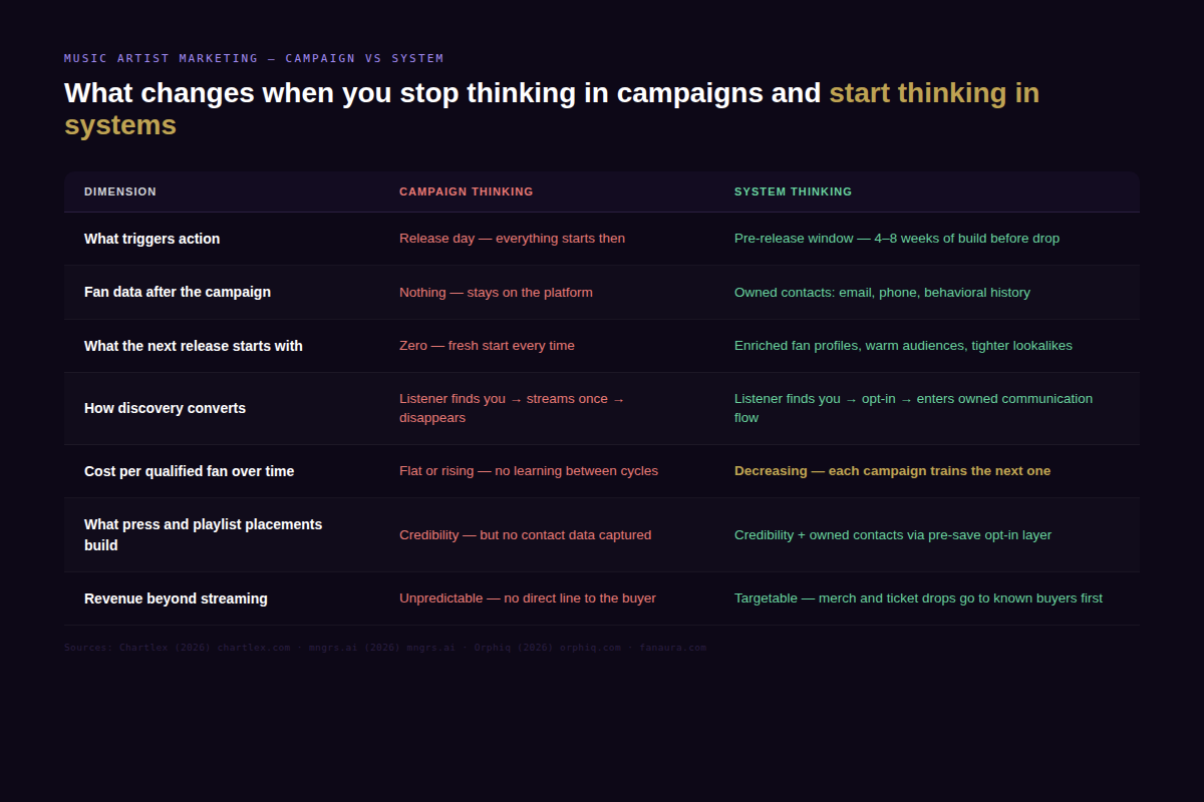
The most important structural shift in music artist marketing is the move from campaigns to systems.
A campaign has a start date and an end date. It spends budget, generates streams, and closes out. The next release starts over.
A system is different: each release teaches it something the previous one could not. Fan profiles grow richer. Lookalike audiences tighten.
The gap between launch day and streaming traction narrows with every cycle.
According to Chartlex's 2026 campaign data, tracks holding a 4.5 percent save rate consistently earn sustained algorithmic carry on Spotify.
That threshold is reached faster when each launch builds on the behavioral data the previous one generated.
The music promo decisions that matter most are the structural ones: where fan data goes after a campaign ends, whether pre-save flows capture contact information or simply route listeners to Spotify, and whether each release enriches a fan profile or disappears into platform analytics the artist cannot access.
What to audit before the next release
Music artist marketing at any budget follows the same structural logic. The scale changes; the sequence does not. Skipping any layer means the next release starts from scratch.
Before the next campaign, it is worth mapping three things:
What the discovery layer covers: which channels move listeners toward the music, and whether each one was chosen based on where the target audience actually spends time
What the capture layer captures: whether the pre-save flow, smart link, and social content all carry an opt-in mechanism - or whether they route fans directly to streaming platforms and capture nothing
What the retention layer retains: whether there is an email or SMS list the artist owns outright, and whether it grows with every release
What a system that compounds looks like in practice
The artists who see compounding returns from music artist marketing have one thing in common: their infrastructure owns what their promotional channels generate - and Fanaura is built around exactly that gap.
The platform connects every layer of the release cycle into a single system:
Fan contact data captured at the pre-release stage, before streaming platforms absorb it
Keyword-triggered DM flows on Instagram and SMS that enrich fan profiles with every interaction
Owned email and SMS lists that grow with each release and communicate independently of algorithm changes
Behavioral data from merch, tours, and pre-saves feeding back into targeting for the next campaign
By launch day, the team knows who those fans are, where they live, and what they are most likely to respond to next.
That is what a release system that compounds looks like - as opposed to a campaign that resets.
If the current approach leaves no data behind after a release, that is the gap worth closing first. Start building the system at fanaura.com.
Take the next step in your music career
Build your career with a marketing team behind you.
Create your account and start planning your next release with Aura Chat.