Music industry marketing strategies: what is actually working in 2026
Understand the music industry marketing strategies that are actually working in 2026, from short-form video and streaming discovery to first-party data and release systems that compound.

Music industry marketing strategies have shifted structurally, and the playbook that worked three years ago no longer applies in the same way.
According to MusicPromoToday's 2026 strategy report, record labels invested approximately $8.1 billion in A&R and marketing globally in 2024.
That scale of investment did not prevent independent artists from gaining ground.
It confirmed that visibility requires deliberate strategy at every budget level - and that the artists building sustainable careers are the ones who treat marketing as infrastructure, not as a final step before release.
Music industry marketing strategies start with understanding where discovery actually happens
The first principle of any effective music industry marketing strategy is accuracy about where new listeners actually come from.
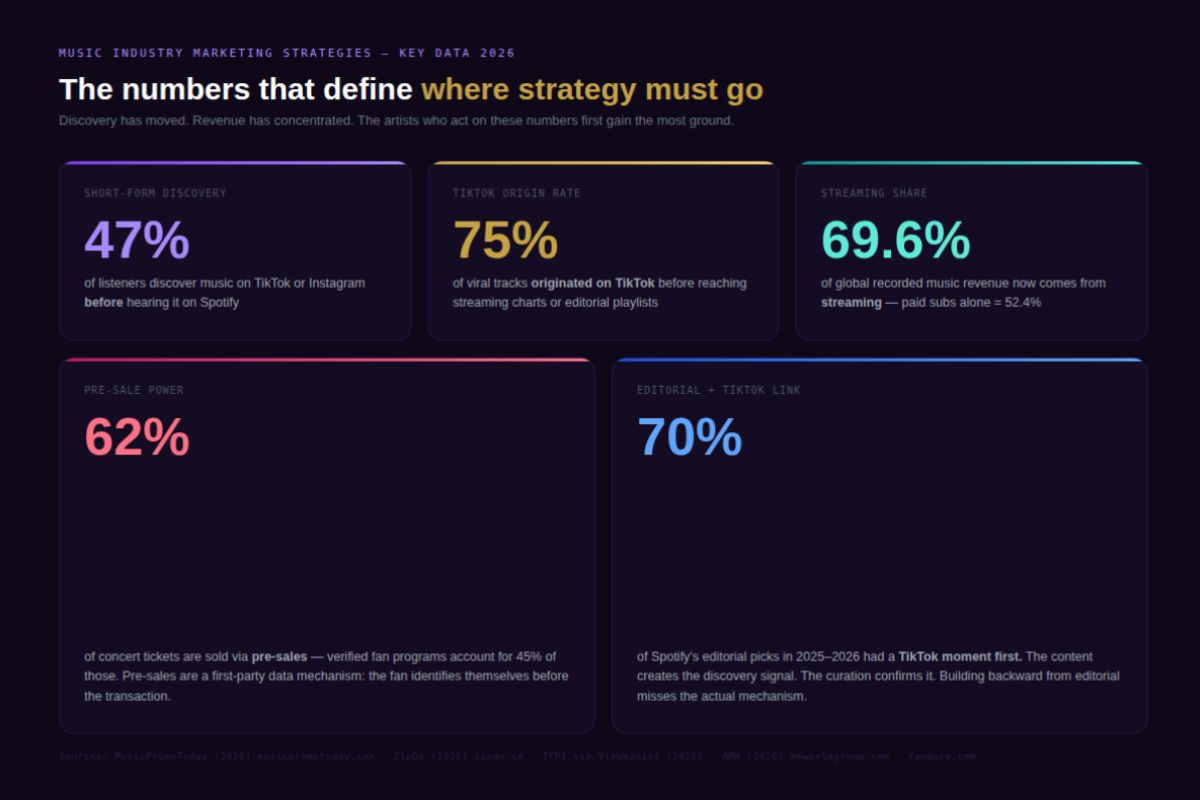
According to MusicPromoToday's analysis, 47 percent of listeners now discover music on short-form video platforms like TikTok or Instagram before hearing it on Spotify.
In other words, social platforms now drive streaming success - not the other way around. According to ZipDo's 2026 music industry statistics, TikTok's music feature alone generates 100 billion monthly video views, with 75 percent of viral tracks originating on the platform before reaching streaming charts.
The structural implication is significant. An editorial playlist placement is no longer the primary discovery mechanism. It is a confirmation mechanism - it amplifies what short-form content already started.
According to AMW's 2026 digital marketing analysis, 70 percent of Spotify's editorial picks had a TikTok moment before the placement. The content came first; the curation followed.
This means the production budget for short-form vertical video is now as strategically important as the audio production budget.
Artists who treat visual content as an afterthought are competing on a field where the rules already changed.
The streaming landscape: what the numbers mean for strategy
Streaming is no longer a growth channel - it is the infrastructure of the music business.
According to IFPI data cited by Viewmaniac's 2026 strategy report, streaming now accounts for 69.6 percent of global recorded music revenue, with paid subscriptions alone making up 52.4 percent of the market.
According to Orphiq's 2026 music industry trends report, global recorded music revenue reached approximately $31 billion in 2025 - but growth has decelerated to single digits in major markets, while the number of tracks uploaded to streaming platforms continues to grow faster than listening hours.
That gap - more tracks, same hours - is the core problem every music industry marketing strategy has to solve.
The biggest playlist placement might generate 50,000 streams, but the relevant question is how many of those streams convert to saved tracks, artist follows, or show attendance.
According to mngrs.ai's 2026 marketing analysis, an independent playlist placement might generate 500 streams at a significantly higher conversion rate to genuine fans than a mass-scale editorial placement.
Reach and conversion are two different metrics, and most strategies optimize for the wrong one.
First-party data: the strategic asset the music industry undervalues
The most consequential shift in music industry marketing strategies over the past two years is not a new platform or format.
It is the recognition that first-party fan data - contact information, behavioral signals, purchase history - is the most durable asset any artist or label can build.
According to Music Ally's roundup of 2026 marketing strategies, industry executives are now explicit about this shift: "Your community spaces and your first-party data is probably where you're going to build your incremental following and start to show what your real footprint will be."
Social following, in this context, is described as increasingly unreliable as platforms shift toward entertainment-first algorithmic feeds.
The structural reason is straightforward. When a fan discovers an artist through a playlist, a TikTok, or a press feature, that interaction lives on the platform that surfaced it. The artist retains nothing.
A fan who opts in with an email address or a phone number, by contrast, enters a channel the artist controls entirely - one that does not reset when an algorithm changes.
This is the gap that separates music promo strategies that compound from those that reset. According to ZipDo's 2026 statistics, 62 percent of concert tickets are sold via pre-sales, with verified fan programs accounting for 45 percent of those sales. Pre-sales are, structurally, a first-party data mechanism: they require the fan to identify themselves before the transaction.
The artists and teams running effective pre-sale campaigns are building the same asset, applied to music releases.
The waterfall release strategy and why timing is a structural decision
Release timing is one of the most underestimated variables in music industry marketing strategy - and the waterfall approach has become the dominant framework among independent artists and mid-tier labels alike.
Rather than releasing full albums immediately, the waterfall strategy releases music gradually: a single, then a second single four weeks later incorporating the first, then a third single at eight weeks, building toward an EP or album at week twelve.
The strategic logic is compounding. Each release teaches the algorithm something new about the audience.
Each release gives the artist another opportunity to run a pre-save campaign, capture new fan contacts, and retarget the audience that engaged with the previous drop.
A single-release model collapses this learning into one moment. The waterfall model extends it across months.
Live music as a marketing channel - not just a revenue line
Live performance has re-entered the conversation as a core marketing strategy, not simply a revenue source.
According to Orphiq's 2026 industry trends report, global live music revenue is projected to exceed $35 billion in 2026, with ticket prices running 20 to 30 percent above 2019 levels in major markets.
The marketing implication is that a live show is the highest-intent fan interaction available. A fan who buys a ticket, attends a show, and purchases merch at the venue has demonstrated three layers of commitment that no streaming metric can replicate.
That fan is also the most likely to respond to a direct communication - an email list opt-in at the merch table, an SMS pre-sale for the next tour leg, a keyword DM trigger from a post-show Instagram story.
The best music marketing platform for capturing that intent is not the one with the most reach. It is the one that turns the moment of highest fan commitment into a durable contact the artist owns past the show.
How to build a music industry marketing strategy that compounds
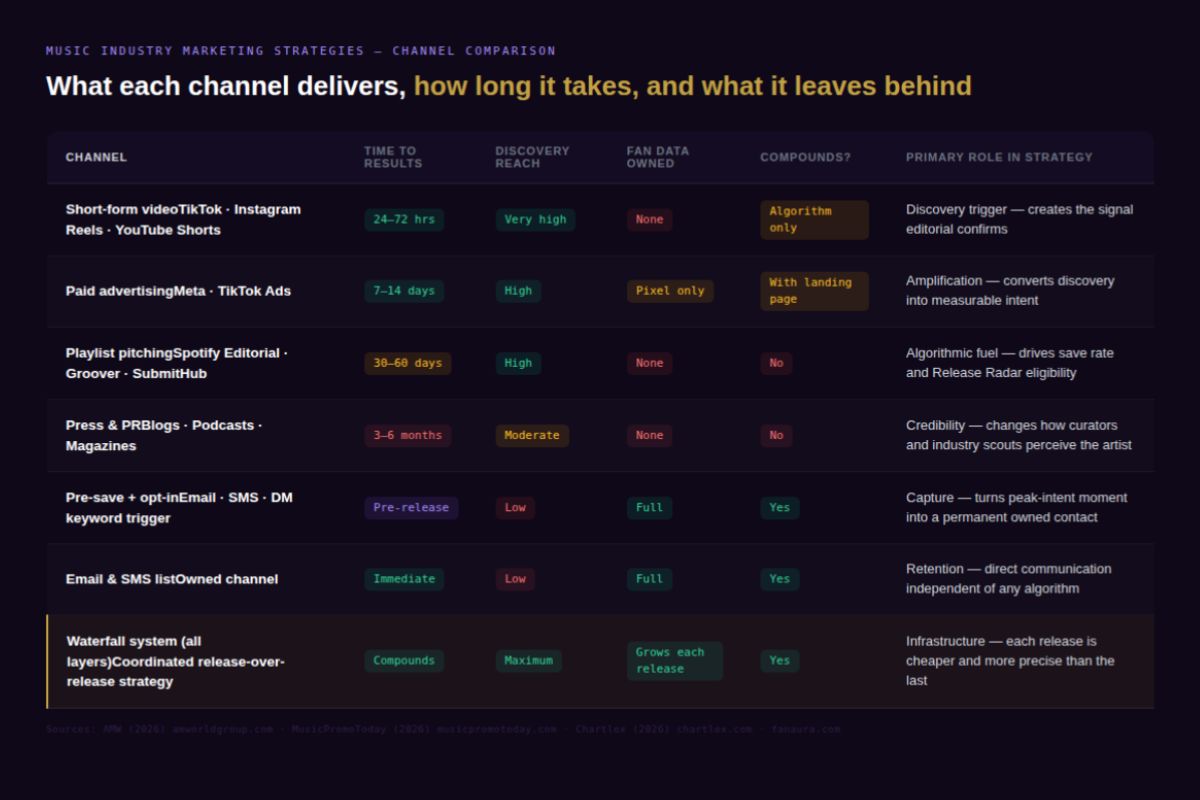
The teams seeing consistent returns from music industry marketing strategies share one structural characteristic: each campaign is designed to leave something behind.
Fan contacts, behavioral data, retargeting pools, and lookalike audiences all carry forward - and each release is cheaper and more precisely targeted than the one before it.
Fanaura connects those layers across every stage of the release cycle:
Short-form content drives discovery and feeds pre-save landing pages that capture fan contacts at peak intent
Pre-save opt-ins via Instagram DM and SMS build owned lists before streaming platforms absorb the audience
Email and SMS sequences communicate directly with fans across release windows, merch drops, and tour announcements, independent of any algorithm
Behavioral data from each release - saves, merch purchases, RSVPs - feeds back into targeting for the next campaign, tightening lookalike audiences and reducing cost per qualified fan
That is what a music artist marketing infrastructure looks like when it is built to compound rather than reset.
The strategies exist. The gap, for most artists and teams, is the system that connects them.
If the current approach does not leave fan data behind after each release, that is the gap worth closing before the next campaign.
Explore how Fanaura structures the full release cycle at fanaura.com.
Take the next step in your music career
Build your career with a marketing team behind you.
Create your account and start planning your next release with Aura Chat.