Music marketing analytics: from data that describes to data that decides
Music marketing analytics describes what happened. The artists who compound use it to decide what to do next. Here is which metrics actually matter.

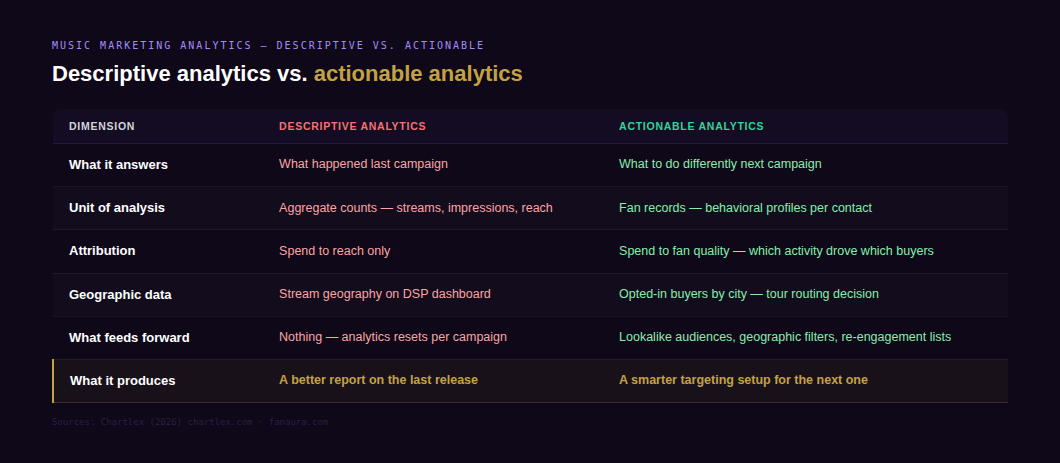
Music marketing analytics is most commonly used as a reporting function - a way to describe what happened after a release.
The artists whose marketing compounds use it as a decision-making tool: one that determines what to do next, which channels produced which fans, and what to adjust before the next campaign begins.
The two uses produce structurally different outcomes. Reporting produces cleaner records of the past. Decision-making produces lower costs and higher precision on each successive release.
The metrics that actually predict outcomes
Most analytics setups track the metrics that are easiest to read, stream count, follower growth, social impressions, rather than the ones that predict algorithmic carry, fan quality, and future revenue.
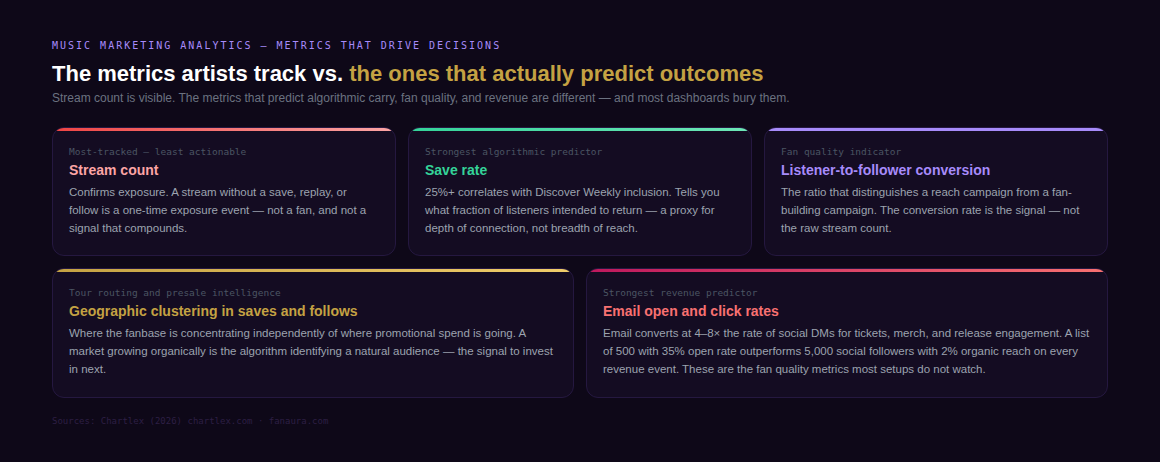
Stream count
Is the most-checked metric and the least useful for decision-making. A high stream count from a playlist placement confirms that many people heard the track. It does not confirm that any of them saved it, will return to it, or are likely to attend a show. A stream without a save, replay, or follow is an exposure event. Exposure does not compound; engagement does.
Save rate
Is the strongest predictor of algorithmic carry. Tracks with a save rate above 25 percent consistently see higher Discover Weekly inclusion rates than tracks below that threshold (Chartlex, 2026).
The save rate tells you what fraction of listeners intended to return - a proxy for depth of connection.
When save rate is low, the question is whether the cause is hook quality, wrong audience targeting, or insufficient first-day concentrated engagement. Each cause has a different fix.
Listener-to-follower conversion
Reveals whether a campaign is producing casual discovers or actual fans. A campaign that generates 10,000 streams and 80 new followers is producing 0.8 percent conversion.
Whether that is strong or weak depends on the channel, but the conversion rate is the signal worth watching, not the stream count.
Geographic clustering
In save and follow data shows where the fanbase is concentrating independently of where promotional spend is going.
A market growing organically is a market the algorithm has identified as a natural audience. That signal should inform tour routing, presale targeting, and future paid spend allocation.
Email and SMS engagement metrics
Are the strongest revenue predictors. Email converts at 4 to 8 times the rate of social DMs for tickets, merchandise, and release engagement (Chartlex, 2026).
A list of 500 contacts with a 35 percent open rate outperforms 5,000 social followers with 2 percent organic reach on every revenue event. These are the fan quality metrics most artist analytics setups do not monitor carefully.
Moving from metric to decision
The analytical pattern that produces compounding results: every metric observation generates a specific next action.
Save rate is low → identify whether the cause is hook quality, wrong audience targeting, or weak first-day engagement from the owned list, and address the specific cause before the next release
Geographic clustering shows unexpected growth → check how many opted-in buyers from that market exist in the fan list and whether venue capacity makes a date viable
Email open rate has dropped → audit subject lines, send timing, and content value, and re-engage lapsed contacts before the next release, not after it
A creator campaign drove strong engagement → check whether those fans entered the owned list or only Spotify, and fix the capture mechanism before the next campaign runs
This pattern requires something most analytics reviews skip: connecting each metric to a specific decision, assigning it a deadline, and checking whether it changed the outcome on the next release.
Analytics that does not change behavior documents the operation. It does not improve it.
The gap between platform data and fan behavior
Every platform produces analytics that describe behavior on that platform. Spotify for Artists shows what happened on Spotify.
Instagram Insights shows what happened on Instagram. Meta Ads Manager shows what happened on Meta. None of them show what happened to the fan who moved across all three.
A fan who discovered an artist through a TikTok creator, followed on Instagram, pre-saved on Spotify, and bought merch through an email link appears in four separate analytics systems as four separate data points.
That person does not appear as a unified record anywhere unless the artist has a fan data layer that captures cross-channel behavior.
Centralized analytics - behavioral event streams flowing into a single fan profile - is the infrastructure that makes data actionable rather than illustrative. No platform dashboard closes this gap.
How Fanaura connects analytics to fan behavioral data
Fanaura's fan profiles generate the behavioral event data that makes music marketing analytics actionable at the contact level.
Every pre-save, DM interaction, merch purchase, and email engagement is recorded per fan - timestamped in that fan's behavioral timeline rather than aggregated into a dashboard number.
When a metric surfaces a question, the fan data provides the answer at contact level:
Which fans caused the save rate spike - identifiable by acquisition source and engagement timeline
Which geographic market has the most opted-in buyers - queryable in real time for presale targeting
Which campaign drove the fans who actually converted - visible in acquisition source data across every channel
Make your music marketing analytics actionable with Fanaura at fanaura.com - connect platform data to fan behavioral profiles, and turn every metric into a decision your next campaign can act on.
Take the next step in your music career
Build your career with a marketing team behind you.
Create your account and start planning your next release with Aura Chat.