What music PR companies actually do and what they leave behind
Understand what music PR companies deliver, what they skip, and how to build the fan data layer that press alone never captures.

Music PR companies are one of the most searched topics among artists preparing for a release, and for good reason.
When 120,000 tracks hit streaming platforms every day (AMW, 2026), press coverage is one of the few signals that cuts through noise with actual credibility.
A single placement in a recognized outlet changes how curators, booking agents, and label scouts perceive an artist overnight.
But press is only part of what a release needs, and understanding that gap is what separates campaigns that compound from ones that stall after the first coverage wave.
What music PR companies are built to deliver
A music PR company earns its fee through relationships. Publicists spend years building trust with journalists, editors, playlist curators, and podcast hosts - and those relationships determine which pitches get opened, which tracks get reviewed, and which artists get featured.
That access is genuinely difficult to replicate independently, especially for emerging acts without prior press history.
The core services most reputable music PR firms offer:
Press release distribution: crafting and pitching a release narrative to relevant blogs, magazines, and online outlets aligned with the artist's genre and audience
Editorial playlist pitching: outreach to independent and editorial curators on Spotify, Apple Music, and genre-specific platforms, timed around the release window
Interview and feature coordination: securing podcast appearances, written profiles, and review features that build a documented body of press coverage over time
Campaign strategy and positioning: identifying the narrative angle most likely to earn coverage, including tie-ins to cultural moments, tour announcements, or artist milestones
Standard campaign timelines run six to eight weeks for a single and eight to twelve weeks for an album cycle (AMW, 2026).
For independent artists, typical investment ranges from $3,000 to $8,000 per single campaign, with monthly retainers landing between $2,000 and $10,000 depending on scope and outlet tier.
What music PR companies are not designed to do
Press coverage builds credibility and surfaces an artist to new listeners, but it rarely captures those listeners for future use.
When a fan reads a blog feature, discovers an artist through an editorial playlist, or hears an interview on a podcast, that interaction lives inside the outlet, not with the artist's team.
The fan's contact information, location, engagement behavior, and buying intent never enter the artist's own system.
This is the structural gap in traditional PR. The coverage itself is valuable. The audience it touches is largely invisible once the campaign ends.
What most PR companies do not cover:
Fan data collection: press placements generate awareness but rarely capture emails, phone numbers, or direct contact information from listeners
Retargeting infrastructure: without pixel data or an owned contact list, there is no way to follow up with fans who discovered the artist through a press campaign
Merch and tour coordination: PR firms focus on media; they do not connect a coverage spike to a merch drop or ticket presale that could convert that attention into revenue
Post-campaign enrichment: once the press cycle closes, there is no mechanism to continue learning about the audience it reached or to re-engage them for the next release
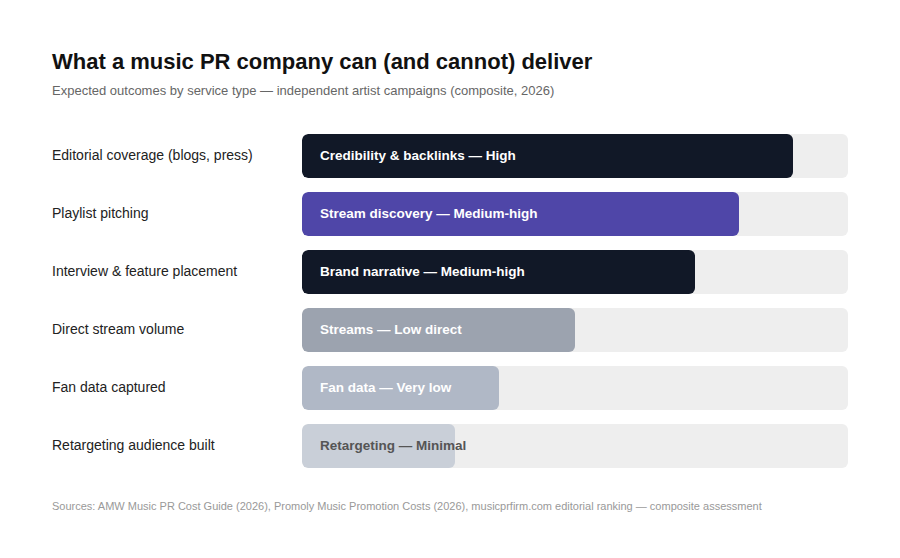
Press coverage consistently rates high on credibility and narrative impact. Where it falls short is data ownership.
The chart below maps what each service type actually produces, which helps teams decide where PR fits within a broader release strategy rather than treating it as the entire plan.
How to choose a music PR company worth the investment
Not every PR firm delivers equal results, and the wrong fit is an expensive lesson. Genre alignment matters more than agency size.
A publicist with deep relationships in indie rock will outperform a larger agency with no contacts in that space, regardless of their roster size or years in business.
The same applies in reverse - a boutique hip-hop PR firm brings little value to an electronic artist targeting European dance outlets.
Questions worth asking before signing:
What outlets have you placed artists in the past 90 days? Recent placements in the right publications are more relevant than a historical client list with recognizable names.
Do you handle pitching in-house or subcontract? Firms that farm pitching to subcontractors have less control over tone, timing, and relationship quality - factors that directly affect placement rates.
What does the campaign timeline look like, and when does pitching start? Effective editorial pitching requires a minimum lead time of four to six weeks before release. Firms that start pitching at release are significantly less effective.
What happens after the campaign ends? Most PR firms close out when the press cycle finishes. Understanding the off-ramp helps teams plan what to do with the audience the campaign surfaces.
Red flags that indicate a lower-quality firm include guaranteed placement promises, pricing that seems unusually low for claimed outlet access, and vague reporting that does not break down specific placements secured.
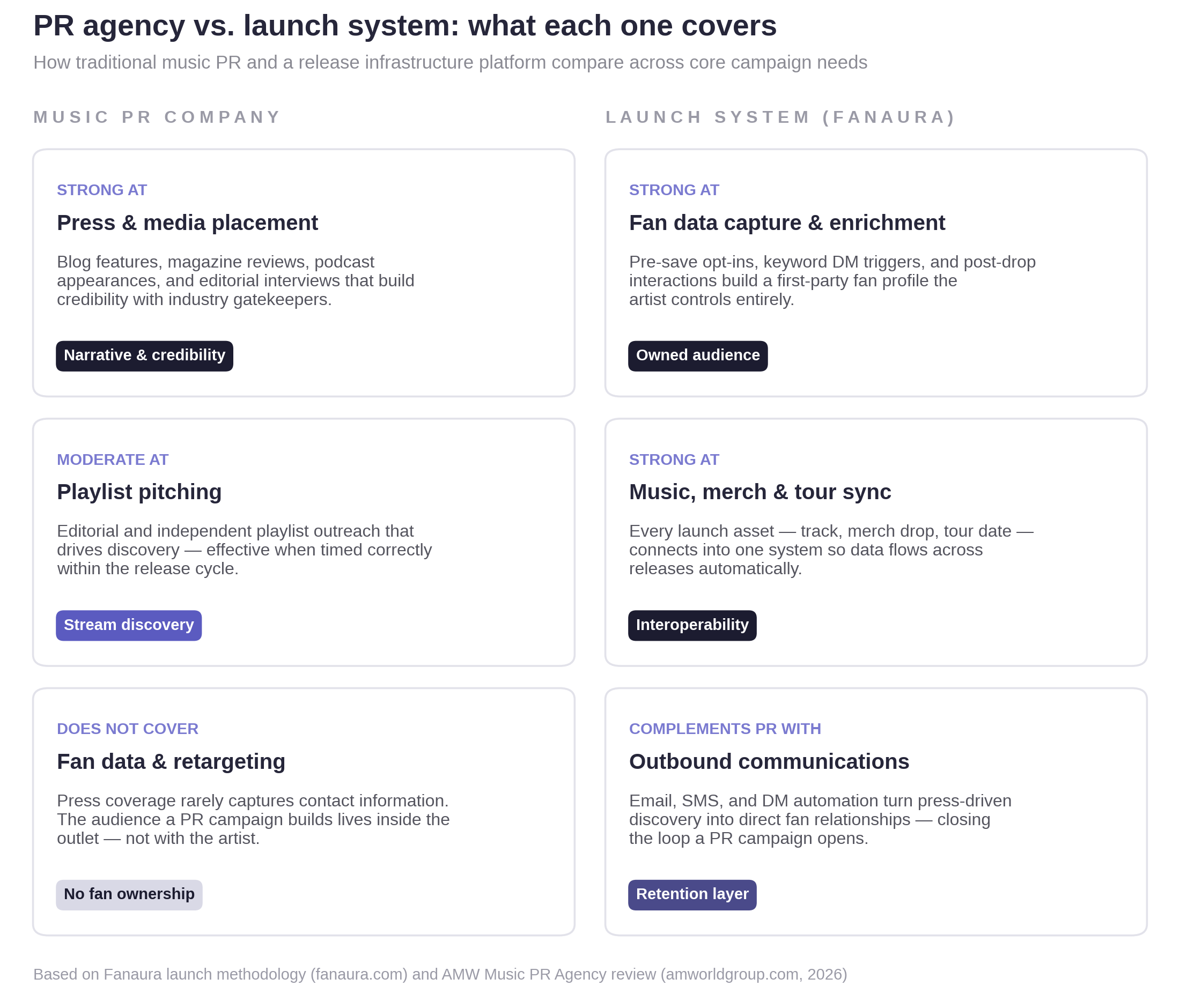
A press campaign and a release infrastructure platform answer different questions.
Knowing where each one starts and stops helps teams layer them intelligently rather than expecting either to do the other's job.
The comparison below maps the core functions of each.
PR works best when it has a system to land into
The artists and teams that extract the most value from music PR companies are not simply those with the biggest press budgets.
They are the ones who treat press coverage as the top of a funnel, not the whole campaign.
Coverage creates discovery. What happens after that discovery is the variable that determines whether a fan becomes a lasting part of the artist's audience - or simply moves on to the next article.
Several factors compound the return on a PR investment:
A pre-save infrastructure is already live before coverage drops, so fans who discover the artist through press have a clear next action that captures their intent
An owned contact list receives a follow-up within 48 hours of a major placement going live, turning readers into subscribers while attention is highest
Merch and tour assets are connected to the same release cycle, allowing a coverage spike to flow directly into a drop or presale rather than dissipating
Fanaura connects those layers. A press campaign surfaces new listeners - and the system captures what happens next.
Fan profiles built through keyword DM triggers, pre-save opt-ins, and post-release interactions give teams the data to retarget, segment, and re-engage the audience a publicist worked to create.
The coverage earns attention. The system converts it into an owned asset that gets smarter with every release.
Music PR companies do excellent work within their scope. Pairing that work with infrastructure that owns what press cannot is how a single campaign becomes the foundation for the next one.
If that layer is missing from the current release process, Fanaura is worth exploring. Contact us!
Take the next step in your music career
Build your career with a marketing team behind you.
Create your account and start planning your next release with Aura Chat.