Music release strategies: how to structure a launch that builds beyond day one
Understand the music release strategies that actually work in 2026: from waterfall sequencing and pre-save infrastructure to the data that separates releases that compound from ones that reset.
Music release strategies determine not just how a track performs on release day, but whether that performance carries forward, compounds, and feeds the next launch.
The decision is structural before it is tactical. An artist who drops ten tracks at once and an artist who releases those same ten tracks over five months are not making a creative choice.
They are making an infrastructure choice - one that determines how much the algorithm learns, how many times the audience can be re-engaged, and whether the release leaves anything behind when the promotional window closes.
Why the release model matters more than the release budget
The core problem with a traditional full-album drop is simple: it collapses every opportunity into a single window.
One release means one shot at editorial consideration, one pre-save campaign, one set of behavioral signals for the algorithm to work with, and one promotional arc before the attention moves on.
The tracks that do not catch in that window - and most do not - start accumulating passive streams with no active promotion driving them.
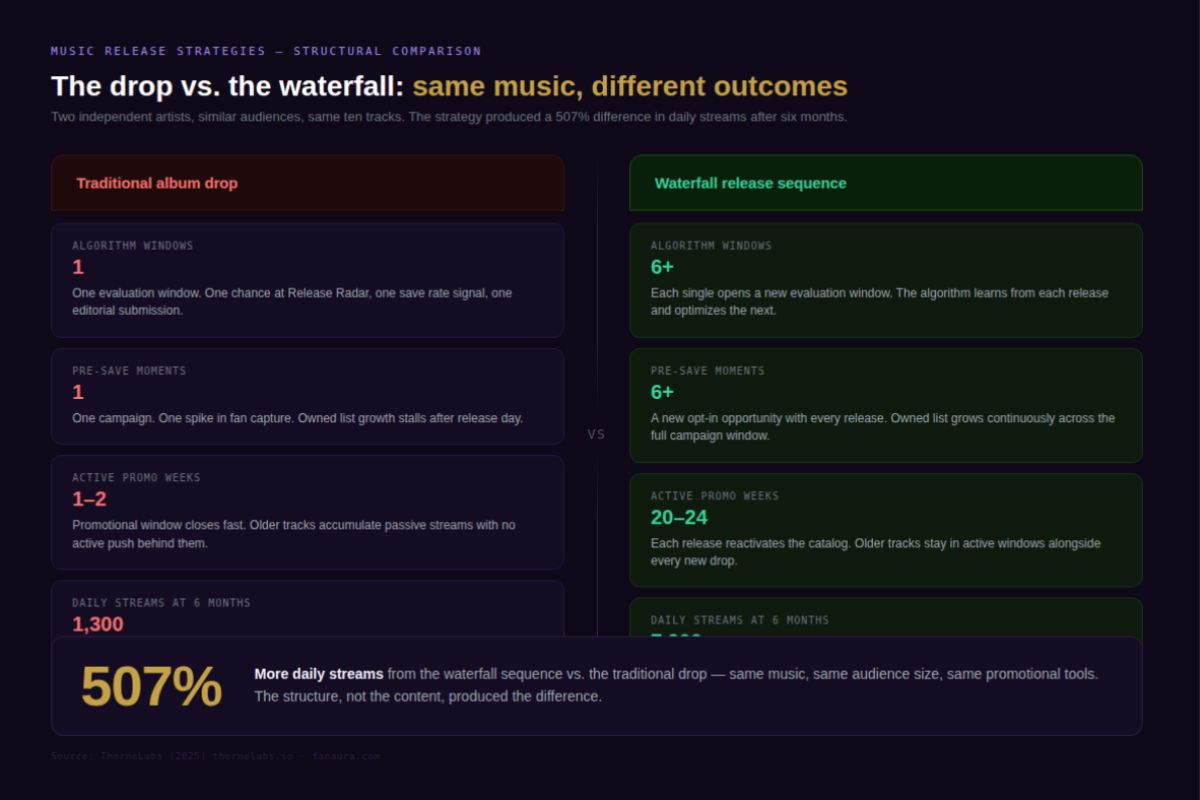
The data makes the gap concrete. According to ThorneLabs' analysis of waterfall vs. traditional release outcomes, two independent artists with similar follower counts released the same ten tracks using different approaches.
The traditional album drop stabilized at 1,300 daily streams across platforms after six months.
The waterfall sequence stabilized at 7,900 - a 507 percent difference - using the same music, the same audience size, and the same promotional tools. The strategy, not the content, produced the gap.
What the waterfall release strategy actually does
A waterfall release strategy is a sequenced approach: one single every four to six weeks, with each new release incorporating the previous tracks so earlier material stays in active promotion windows alongside the new drop.
The mechanism matters more than the calendar. Each release in the sequence gives the algorithm a new evaluation window - a fresh opportunity to test the track in Release Radar, to measure save rates, and to determine whether the artist earns placement in Discover Weekly.
A single album drop receives one evaluation. A six-single waterfall sequence receives six. Each one builds on the behavioral data the last one generated.
Beyond the algorithm, the waterfall creates something equally valuable: multiple pre-save campaigns.
Each release is a legitimate reason to ask fans to opt in, to capture an email address or phone number, and to add a contact to an owned list the artist controls past the campaign.
A traditional album drop creates one pre-save moment. A waterfall sequence creates as many as the number of releases in the cycle - which means the owned list grows continuously across the entire campaign rather than spiking once and stalling.
The pre-save window: where most music release strategies lose ground
The pre-release window is where the structural advantage of any music release strategy is either built or abandoned.
According to Viewmaniac's 2026 strategy analysis, nearly 70 percent of fans who pre-save an album stream it in the first week.
That statistic describes intent - not passive discovery, but active anticipation. A fan who pre-saves has made a commitment.
The pre-save number tells the algorithm that demand exists before the track even drops, which is why a strong pre-save count triggers algorithmic playlist consideration on day one rather than waiting for organic traction to accumulate.
The mistake most artists make is treating the pre-save as a vanity metric - something to post about - rather than as the primary fan capture mechanism of the entire campaign.
A pre-save link that routes fans directly to Spotify captures zero contact data. The platform retains everything.
A pre-save flow built on a landing page with an email or SMS opt-in captures the fan at the moment of highest intent, before the streaming platform absorbs them entirely.
That distinction determines whether each release builds an owned audience or simply borrows attention from a platform that keeps the relationship.Music release strategies determine not just how a track performs on release day, but whether that performance carries forward, compounds, and feeds the next launch.
The decision is structural before it is tactical. An artist who drops ten tracks at once and an artist who releases those same ten tracks over five months are not making a creative choice.
They are making an infrastructure choice - one that determines how much the algorithm learns, how many times the audience can be re-engaged, and whether the release leaves anything behind when the promotional window closes.
Why the release model matters more than the release budget
The core problem with a traditional full-album drop is simple: it collapses every opportunity into a single window.
One release means one shot at editorial consideration, one pre-save campaign, one set of behavioral signals for the algorithm to work with, and one promotional arc before the attention moves on.
The tracks that do not catch in that window - and most do not - start accumulating passive streams with no active promotion driving them.
The data makes the gap concrete. According to ThorneLabs' analysis of waterfall vs. traditional release outcomes, two independent artists with similar follower counts released the same ten tracks using different approaches.
The traditional album drop stabilized at 1,300 daily streams across platforms after six months.
The waterfall sequence stabilized at 7,900 - a 507 percent difference - using the same music, the same audience size, and the same promotional tools. The strategy, not the content, produced the gap.
What the waterfall release strategy actually does
A waterfall release strategy is a sequenced approach: one single every four to six weeks, with each new release incorporating the previous tracks so earlier material stays in active promotion windows alongside the new drop.
The mechanism matters more than the calendar. Each release in the sequence gives the algorithm a new evaluation window - a fresh opportunity to test the track in Release Radar, to measure save rates, and to determine whether the artist earns placement in Discover Weekly.
A single album drop receives one evaluation. A six-single waterfall sequence receives six. Each one builds on the behavioral data the last one generated.
Beyond the algorithm, the waterfall creates something equally valuable: multiple pre-save campaigns.
Each release is a legitimate reason to ask fans to opt in, to capture an email address or phone number, and to add a contact to an owned list the artist controls past the campaign.
A traditional album drop creates one pre-save moment. A waterfall sequence creates as many as the number of releases in the cycle - which means the owned list grows continuously across the entire campaign rather than spiking once and stalling.
The pre-save window: where most music release strategies lose ground
The pre-release window is where the structural advantage of any music release strategy is either built or abandoned.
According to Viewmaniac's 2026 strategy analysis, nearly 70 percent of fans who pre-save an album stream it in the first week.
That statistic describes intent - not passive discovery, but active anticipation. A fan who pre-saves has made a commitment.
The pre-save number tells the algorithm that demand exists before the track even drops, which is why a strong pre-save count triggers algorithmic playlist consideration on day one rather than waiting for organic traction to accumulate.
The mistake most artists make is treating the pre-save as a vanity metric - something to post about - rather than as the primary fan capture mechanism of the entire campaign.
A pre-save link that routes fans directly to Spotify captures zero contact data. The platform retains everything.
A pre-save flow built on a landing page with an email or SMS opt-in captures the fan at the moment of highest intent, before the streaming platform absorbs them entirely.
That distinction determines whether each release builds an owned audience or simply borrows attention from a platform that keeps the relationship.
Timing within the release cycle: what each phase is actually for
A music release strategy is not a single event with a promotional tail. It is a sequence of distinct phases, each with a different objective - and collapsing those phases into one another is the structural error most campaigns make.
The phases that produce compounding results:
Six to eight weeks out - build: editorial playlist pitching via Spotify for Artists, press outreach to blogs and podcasts, pre-save landing page live and driving traffic. This phase is about earning algorithmic consideration and capturing early intent before any spend.
Two to three weeks out - capture: paid advertising begins, driving traffic to the pre-save page rather than to Spotify directly. Short-form video content ramps up with hook variations targeting different audience segments. Every touchpoint has an opt-in mechanism attached.
Release week - launch: pre-save data signals demand to the algorithm; owned list receives direct outreach on drop day; press coverage amplifies what short-form content already started. The release week is a confirmation mechanism, not a discovery mechanism.
Weeks two and three - sustain: the campaigns that collapse here are the ones that treat release day as a finish line. A track with steady week-two promotion consistently outperforms one with a launch-day spike and no follow-through. The algorithm is still evaluating; the audience is still discovering.
What each music release strategy leaves behind
The question that separates release strategies that compound from ones that reset is not which model produced the most streams.
It is what the release left behind when the promotional window closed.
A traditional album drop, executed well, leaves behind a streaming catalog and a press clipping.
A waterfall sequence, executed with the right infrastructure, leaves behind something more durable: a richer fan profile, a larger owned list, a tighter lookalike audience, and a retargeting pool the next campaign can build from on day one rather than starting from scratch.
The music promo decisions that produce this outcome are structural ones made before the campaign starts - not tactical adjustments made after release day.
Whether the pre-save flow captures contact data, whether the landing page fires pixel conversion events, whether the owned list receives direct outreach at each phase: these are the variables that determine whether the release teaches the system something the previous one could not.
How Fanaura connects the release cycle into a single system
The artists seeing compounding returns from their music release strategies are not running more campaigns.
They have built the infrastructure that makes each campaign smarter than the last - and Fanaura is built around exactly that architecture.
The platform connects every phase of the release cycle into one system:
Pre-save opt-ins captured via Instagram DM and SMS before streaming platforms absorb the fan
Owned email and SMS lists that grow with every release and communicate independently of algorithm changes
Behavioral data from saves, merch purchases, and RSVPs feeding back into targeting for the next release
Lookalike audiences that tighten with each campaign, reducing cost per qualified fan over successive releases
That is what a release system that compounds looks like - one where the fifth release is cheaper, faster, and more precisely targeted than the first, because every prior campaign left something behind.
If the current release approach resets with every drop, that is the gap worth closing before the next one. Explore how Fanaura structures the full release cycle at fanaura.com.
Take the next step in your music career
Build your career with a marketing team behind you.
Create your account and start planning your next release with Aura Chat.