Musicians manager software: what to look for when you are managing a career, not just living one
Musicians manager software helps you coordinate releases, track revenue, and manage multiple artists, but the fan data layer most tools leave out is where career momentum actually builds.
Musicians manager software solves a different problem than artist tools do. An artist managing their own career needs scheduling, content planning, and release coordination.
A manager overseeing one or several artists needs all of that - plus visibility across multiple campaigns simultaneously, contract and revenue tracking, and a way to ensure that what happens on one artist's campaign does not create blind spots on another's.
The distinction matters when evaluating tools. Most platforms are built with the artist as the user. The manager's workflow is structurally different, and the gaps show up quickly when a tool designed for self-management gets stretched across a full roster.
What musicians manager software is actually being asked to do
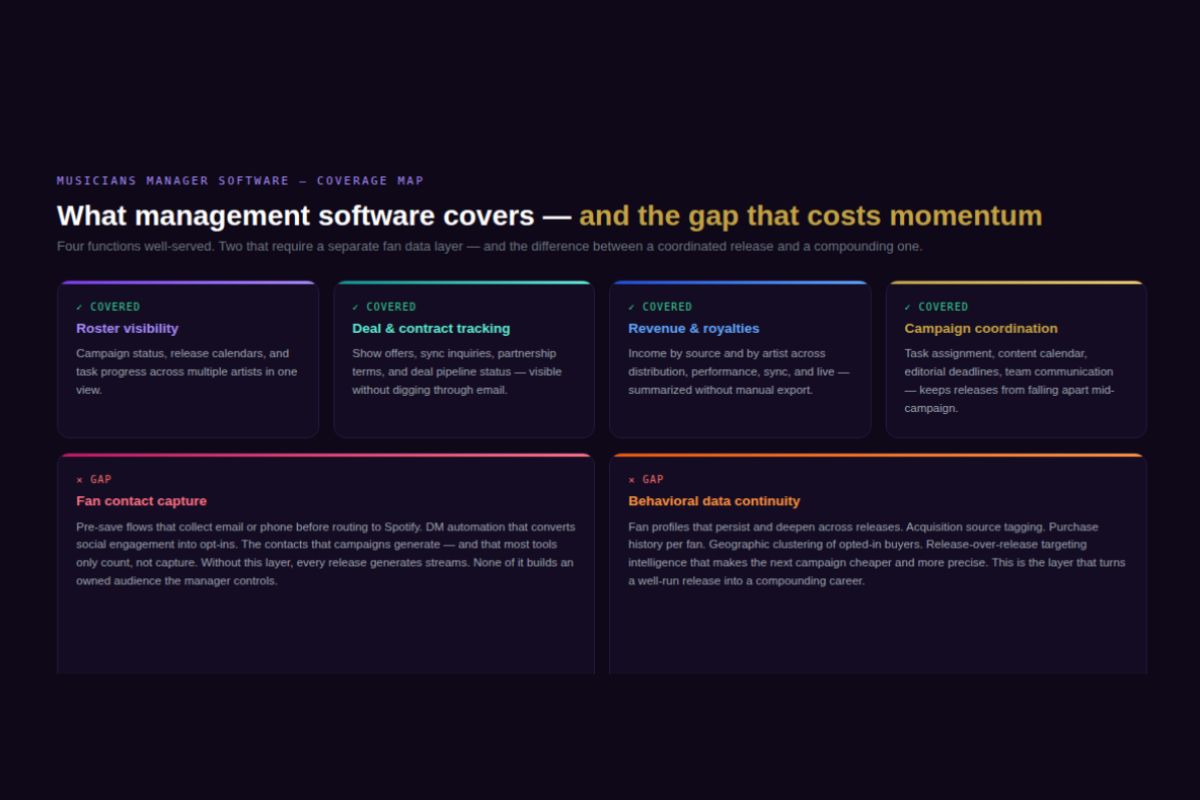
A manager's day-to-day spans four distinct operational layers. Understanding them separately makes it easier to identify which tools cover which gaps.
Roster visibility is the first requirement that separates manager software from artist software. A manager overseeing three artists needs to see each one's release calendar, task status, and campaign progress without switching between three separate dashboards or asking each artist to send weekly updates.
A single view across all active projects is the feature most artist-facing tools do not provide, because they were never designed for the manager's vantage point.
Contract and deal tracking is the layer that generic project management tools handle poorly. Show offers, sync inquiries, label negotiations, brand partnership terms: each one has a status, a deadline, and a contact on the other side.
Losing track of an open deal is losing money. Managers need a system that keeps active deal pipelines visible and surfaceable, not buried in email threads.
Revenue and royalty oversight across multiple income streams - distribution, performance royalties, sync fees, merchandise, live - requires more than a spreadsheet, especially across multiple artists.
The manager who cannot answer "what did artist X earn last quarter and from which sources" without a 20-minute data gathering exercise is working with incomplete visibility.
Campaign coordination is where the fan data problem surfaces. A manager who runs a pre-save campaign, an influencer activation, and a press push for a release - and cannot tell, at the campaign's end, which of those activities drove the most owned fan contacts - is flying blind on the decisions that matter most for the next release.
The fan data gap that musicians manager software consistently misses
Most musicians manager software platforms are excellent at the coordination and reporting problems. They are structurally weak on the fan relationship problem, and this is where career momentum actually builds or stalls.
A manager who runs ten releases over two years and ends each cycle with only streaming analytics and press clippings is starting from scratch on release eleven.
No accumulated fan contact data. No behavioral profiles. No retargeting pools that get tighter because the previous campaigns taught the system something. The coordination was clean. The fan data layer was empty.
The artists whose careers compound - not because of a single viral moment, but because each release builds tangibly on the last - have managers who treated every campaign as a fan capture event, not just a promotional event.
Every pre-save collected an email or a phone number. Every influencer post had a keyword trigger that fired a DM flow. Every show had a merch table opt-in. The fans accumulated. The targeting got cheaper. The owned list got more valuable.
That layer does not live inside most musicians manager software. It requires a dedicated fan data infrastructure running alongside the coordination tools.
How to evaluate musicians manager software for a real management workflow
The evaluation frame that avoids feature-list paralysis: what does the tool make easier on Monday morning?
For the coordination layer, the questions worth asking:
Can I see all active artist campaigns in one view, or does the tool require switching between per-artist accounts?
Does it handle deal and contract tracking in a way that makes open pipeline visible without manual status updates?
Does it generate revenue summaries that break down income by source and by artist without requiring manual data export and manipulation?
For the fan data layer, the questions most managers forget to include:
Does the tool capture fan contacts from pre-save campaigns - or does it only report pre-save counts to a dashboard?
Can I see which promotional activity drove which fan contacts, so I know what to replicate on the next release?
Does fan behavioral data carry forward from one release to the next - or does each campaign start from the same empty baseline?
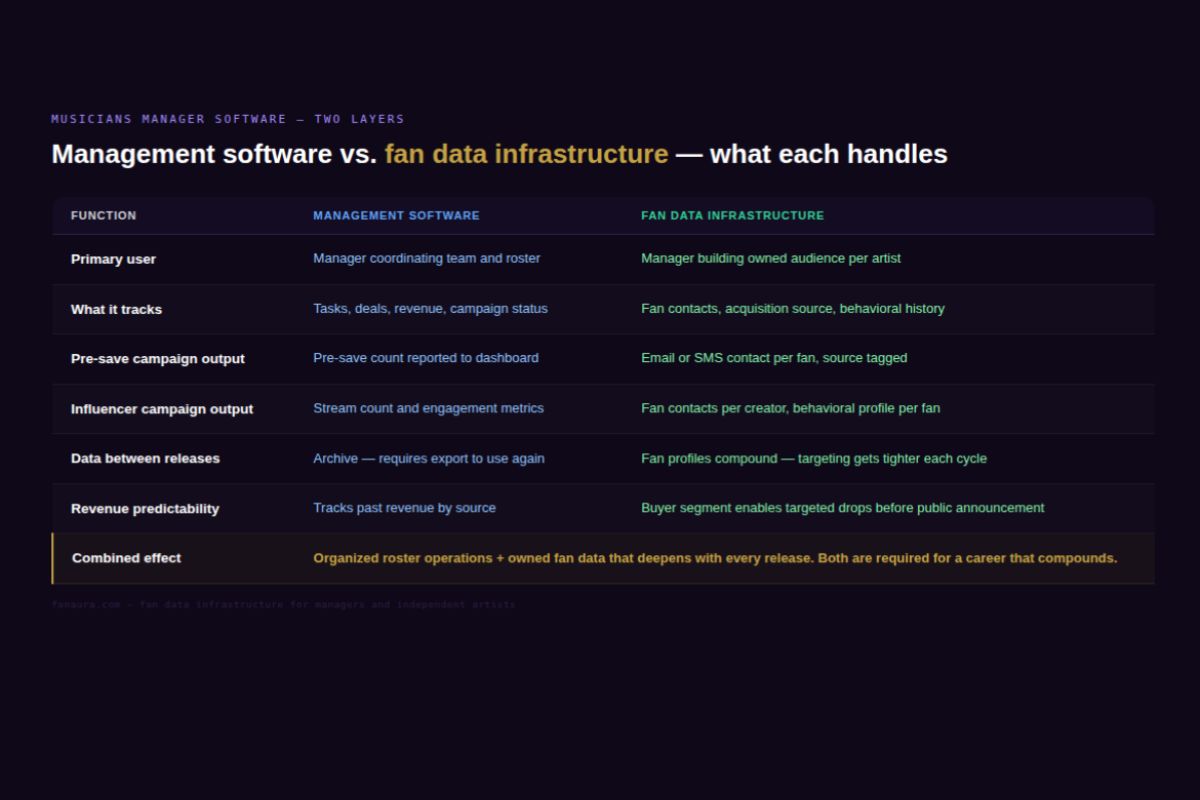
If the answer to the second set of questions is no, the tool needs to be paired with a fan capture system. Managing the career and building the fanbase are two different operational problems. The best managers solve both - with tools designed for each.
What the coordination and fan data layers look like working together
The release planned in musicians manager software runs more precisely when the team going into week one knows: which fans from previous releases are already opted in, which cities have the highest concentration of buyers, and which promotional channel drove the contacts who converted best last time.
That intelligence does not come from a scheduling tool. It comes from having treated every previous release as a data-gathering exercise - capturing fan contacts at every touchpoint and letting that behavioral history inform the next campaign's targeting.
The music release strategies that produce compounding results across a managed roster are the ones where both layers run simultaneously. Coordination keeps the team aligned. Fan data makes the team smarter with every release.
Where Fanaura fits in a manager's stack
Fanaura is not a replacement for musicians manager software. It is the fan data layer that most management tools leave out - built to run alongside whatever scheduling and analytics tools already work.
For managers, Fanaura connects:
Pre-save flows with opt-in capture - every campaign generates owned contacts per artist, not just pre-save counts
Keyword DM automation on Instagram - influencer posts and social content convert engagement into contacts automatically, tagged by source
Fan profiles per artist - behavioral history that persists across releases, showing which fans engage consistently and what they respond to
Cross-release targeting intelligence - lookalike audiences and retargeting pools that tighten with every campaign, reducing cost per qualified fan over the roster
Add Fanaura to your management stack at fanaura.com and make sure the fan data layer your artists need is actually being built, not just assumed.
Take the next step in your music career
Build your career with a marketing team behind you.
Create your account and start planning your next release with Aura Chat.