Niche music influencers: why smaller creators drive better results for independent artists
Niche music influencers outperform mega-accounts for independent artists. Understand why smaller creators convert better, and how to build campaigns that compound beyond a single placement.
Niche music influencers - creators with focused audiences in a specific genre, mood, or listening context - consistently outperform larger accounts for independent artist campaigns. The reason is structural, not aesthetic.
A creator with 15,000 followers who posts exclusively about bedroom pop has an audience that self-selected around a specific taste. When that creator features a track, the recommendation carries the same weight as a trusted peer.
A creator with 2 million followers posting across music, lifestyle, and entertainment has an audience that assembled around entertainment value. The trust is different. The conversion is different.
Why niche beats scale in music influencer marketing
The assumption that larger audiences yield better results has been effectively disproven.
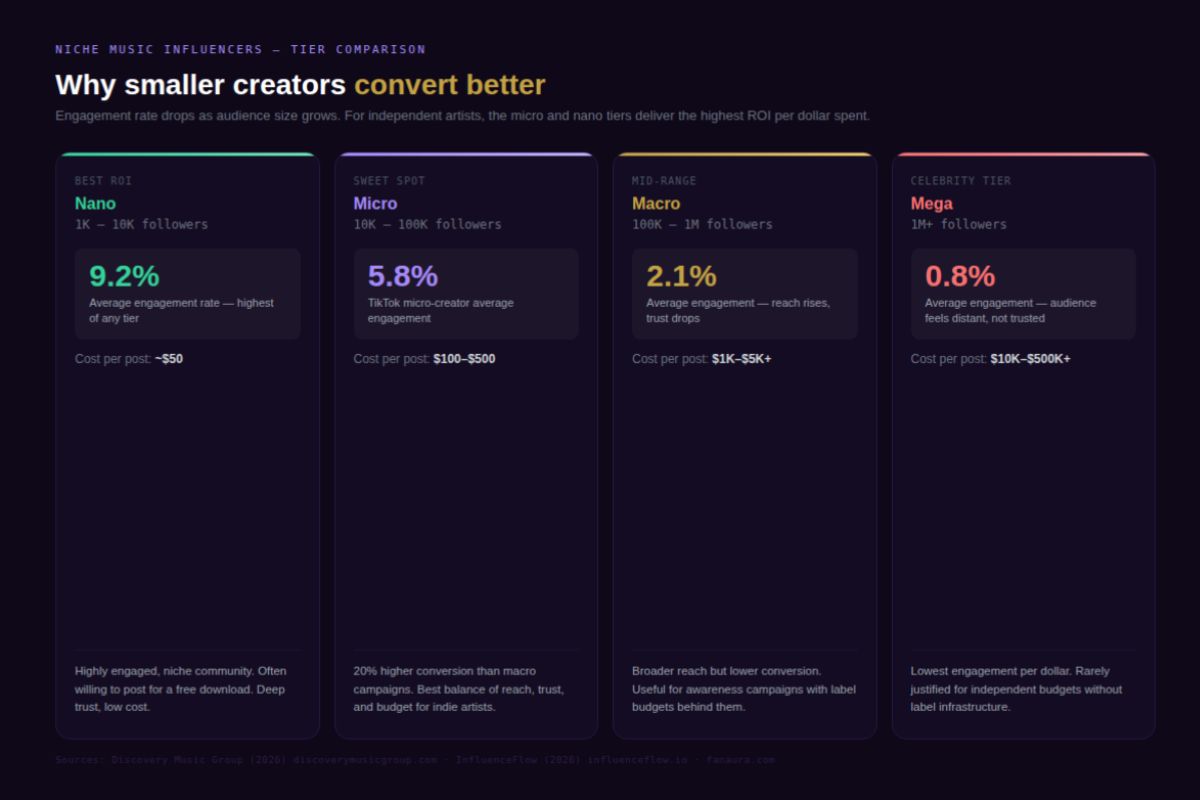
Micro-influencers, typically defined as creators with 10,000 to 100,000 followers, deliver 20% higher conversion rates than macro-influencer campaigns at equivalent spend (Discovery Music Group, 2026).
On TikTok specifically, micro-creators average 5.8% engagement against a macro average that drops below 2% at scale.
The mechanism is straightforward. A niche creator's audience treats them as a tastemaker within a community they already belong to.
When the creator says "this track belongs in your rotation," the listener believes it, because that creator has demonstrated taste alignment consistently, not because they have a large platform.
For independent artists with real-world budgets, this gap matters practically. Five micro-influencer placements at $100–$500 each spread across a release window consistently outperform one macro placement at the same total spend. The micro campaign reaches five distinct audience clusters, generates five organic recommendation moments, and - if structured correctly - produces five retargeting seeds rather than one.
How to find the right niche music influencers
Genre alignment is the first filter. A niche creator who posts "dark ambient for late-night drives" reaching an artist releasing upbeat pop produces almost nothing.
The audience is not predisposed to convert. Finding creators whose existing content already sounds like the artist's world - in mood, in aesthetic, in the language they use to describe music - is the prerequisite that most artists skip in favor of follower count.
Practical discovery methods:
Search within Spotify's "Fans Also Like" - the artists surfaced there have audiences that already overlap with the target listener. Cross-reference those artists' TikTok and Instagram presence to find who is posting about them.
Search long-tail keywords on TikTok - not just genre names, but moods and contexts. "Late night indie," "hypnotic electronic," "sad girl autumn" - these searches surface creators whose audiences are already oriented around the feeling the music evokes.
Check the "Discovered On" section on similar artists' Spotify profiles. The playlists and curators listed there are often running adjacent social content.
The size check comes after the alignment check. A creator with 8,000 followers whose audience is exactly right will outperform a creator with 80,000 followers whose audience is adjacent but not precisely aligned.
How to brief a niche creator for music content
The brief is where most influencer campaigns fail - not the selection. A creator who receives an overly scripted brief produces content that their audience immediately reads as an ad.
Their audience stops trusting the recommendation. The placement fails at the brief, not at the posting.
A brief that converts gives the creator a clear direction with flexible execution. Specify the mood to evoke, the exact section of the track to feature - usually the most distinctive hook within the first 10 seconds - and the call to action.
Then let the creator execute in their own voice. Creators know their audience better than the artist does. Over-briefing eliminates the authenticity that made the creator valuable in the first place.
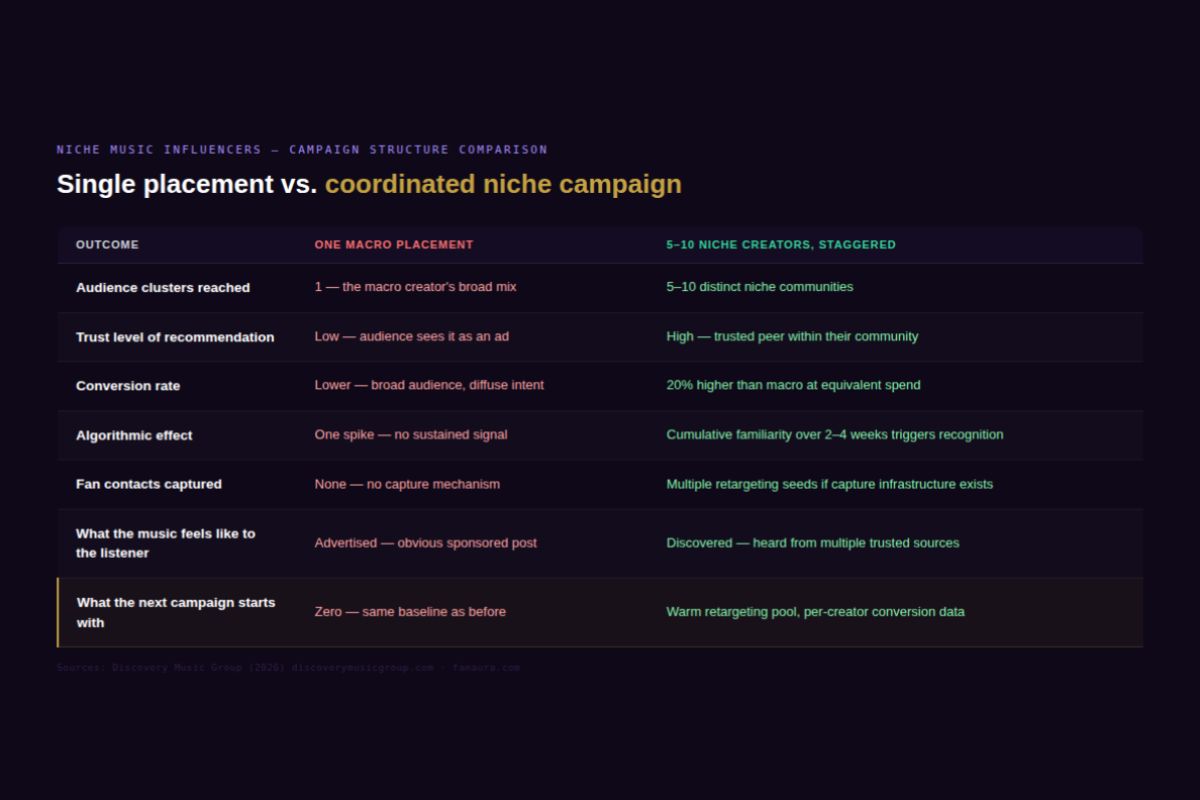
The timing structure matters as much as the content. A single placement is an event. A staggered campaign is a movement.
Five to ten niche creators posting across a two-to-four-week window - not all on the same day - creates the cumulative familiarity that drives algorithmic recognition.
When listeners encounter the same track from multiple trusted sources across several weeks, the music feels discovered rather than advertised.
What niche influencer placements leave behind - and what they do not
A well-executed niche music influencer campaign generates genuine discovery. New listeners hear the track in a trusted context. Some of them save it. Some follow the artist. The campaign earns real streaming behavior.
What it does not generate, structurally, is an owned contact. A listener who discovers an artist through a TikTok creator and clicks through to Spotify is a new monthly listener.
The artist captures nothing about who they are, where they live, or how to reach them again without depending on the algorithm to resurface the track.
The artists who compound results from influencer campaigns are the ones who pair each placement with a capture mechanism on the other side.
A pre-save landing page behind the link in bio. A DM automation triggered by a keyword the creator drops in the caption. An email opt-in that activates before the Spotify redirect.
When that infrastructure exists, a niche influencer campaign does two things simultaneously: it generates discovery in the creator's audience, and it converts a fraction of that discovery into owned contacts that the artist controls past the campaign window. One without the other is a campaign. Both together is a system.
How Fanaura connects influencer discovery to fan capture
The gap between a niche music influencer placement and a compounding fanbase is the capture mechanism - and Fanaura is built to close it.
When an influencer posts using a keyword trigger, a Fanaura-powered DM automation captures every fan who engages and routes them toward a pre-save opt-in.
The listener who would have become a monthly listener becomes a named contact with a behavioral profile.
By the next release, the team knows how that fan was acquired, what they engaged with, and what they are most likely to act on next.
Every influencer campaign, connected to Fanaura's capture infrastructure:
Keyword DM triggers on creator posts - engagement in the creator's audience converted into opt-ins before routing to Spotify
Pre-save landing pages - the destination behind every influencer link, capturing contact before the stream
Fan profiles built per acquisition source - knowing which creator drove which fan, which audience cluster converts best, which partnerships are worth repeating
Retargeting pools fed by each campaign - the next influencer campaign starts with a warm audience, not from zero
Don't let influencer placements generate discovery that disappears. Connect your campaigns to Fanaura - add keyword DM capture to every creator post, build pre-save flows that collect contacts before the Spotify redirect, and know exactly which niche partnership drove which fan to your next release.
Take the next step in your music career
Build your career with a marketing team behind you.
Create your account and start planning your next release with Aura Chat.