Pitfalls in label marketing: the structural mistakes that stall campaigns before they start
The most damaging pitfalls in label marketing are structural, not tactical. Understand what labels get wrong, and what any team can fix before the next campaign.

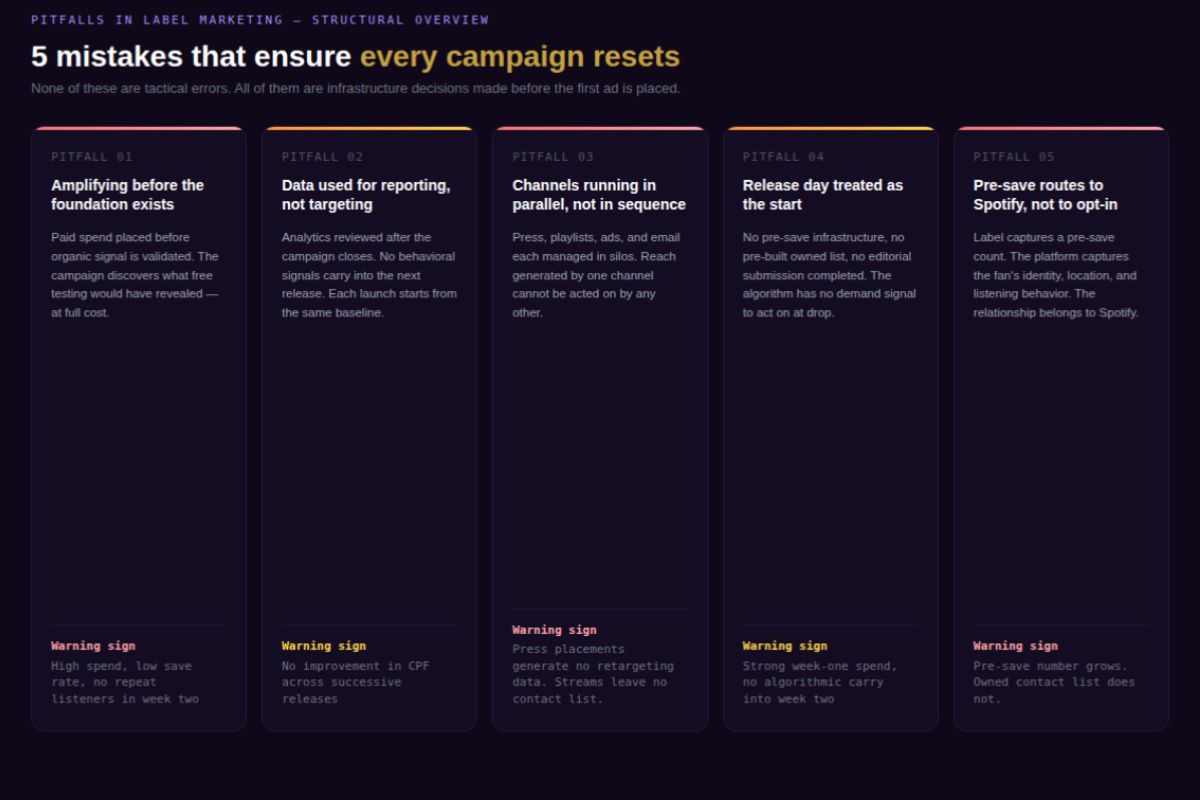
The most damaging pitfalls in label marketing are not tactical errors. They are structural ones - decisions made before a single ad is placed or a single pitch is sent that determine whether the campaign can work at all.
Labels of all sizes repeat the same patterns: spending on reach before there is a foundation to convert it.
They treat launch day as the start of the campaign, not as confirmation of momentum that should have been built beforehand.
They also run promotional channels in isolation, so data from one channel does not feed or improve the others.
Each mistake is individually fixable. Together, they ensure that most campaigns reset with every release rather than compounding toward something durable.
Amplifying before there is anything to amplify
The most costly pitfall in label marketing is investing in paid amplification before the artist has demonstrated any organic signal worth scaling.
The framing that makes this clearest comes from Revelator's 2026 breakdown of what actually moves the needle in music marketing: the biggest mistakes are not bad strategy - they are a misunderstanding of the artist's stage of development.
An artist just starting out is in a reps stage, not a rollout stage. The goal at that point is to establish what content format resonates, what the artist's world looks and sounds like, and how to communicate with an audience in a way that feels repeatable.
Paid spend placed before that foundation exists delivers little because there is nothing to amplify yet.
Labels miss this distinction because the incentive structure pushes toward visible activity. A paid campaign is a line item on a budget.
Organic content testing is not. The result is that artists get rolled out with full promotional budgets before anyone - including the label - knows which angle of the artist resonates with a real audience.
The campaign spends money discovering what organic testing would have revealed for free.
The correction is sequential: test content formats organically first, identify which hooks generate genuine saves and shares rather than passive impressions, and then direct paid spend toward amplifying what the organic signal already confirmed.
Paid promotion applied to a validated signal converts at a structurally different rate than paid promotion applied to an unvalidated one.
Treating data as a reporting tool instead of a targeting asset
Most labels treat streaming analytics, social engagement metrics, and ad performance data as reporting tools - numbers that describe what already happened.
The teams that compound results treat the same data as targeting infrastructure for what comes next.
The gap is significant. A label that runs a campaign, reviews the numbers, and files them has learned something about the last release.
A label that feeds save rate patterns, audience geographic data, and engagement signals into the next campaign's targeting parameters has built something the previous release could not have started with.
Every campaign should be teaching the system something the previous one could not.
This is the structural reason most label campaigns fail to improve release over release. The data exists. The insight is often visible.
But without a mechanism that carries behavioral signals from one campaign into the next - tighter lookalike audiences, enriched fan profiles, retargeting pools built from confirmed intent - each release starts from the same baseline as the last.
The broader principle is well established: 100 genuinely connected fans who attend shows and buy merch create more long-term career value than 10,000 passive streams from listeners who cannot recall an artist's name a week later (mngrs.ai, 2026).
The metric that matters is not reach. It is whether the campaign built something the next one can start from.
Running promotional channels as independent operations
A label marketing campaign that treats paid ads, playlist pitching, press outreach, and email as separate workstreams - each managed by a different team with different metrics and no shared data layer - is structurally unable to compound.
The mechanism is straightforward. A fan who discovers an artist through a press placement is a reader in someone else's ecosystem.
A fan who discovers the same artist through a TikTok is a viewer in a platform's ecosystem.
Neither of those fans enters the artist's own system unless there is explicit infrastructure designed to capture them - a pre-save flow with an opt-in, a landing page that fires a pixel conversion event, a DM automation that collects a phone number at the moment of peak intent.
When channels operate independently, each one generates reach that disappears at the edge of the platform that produced it.
The press placement earns credibility but leaves no contact data. The playlist placement earns streams but leaves no behavioral signal the label can act on.
The paid ad earns clicks but leaves no retargeting pool unless the traffic was routed through a landing page rather than directly to Spotify.
None of these is a failure of the individual channel. Each is a failure of the system connecting them.
The best music marketing platform is not the one that performs best on any single channel.
It is the one that makes what happens on each channel available to every other one - so that a press placement becomes a retargeting seed, a pre-save becomes a contact, and a merch purchase becomes a behavioral signal that narrows the audience for the next campaign.
Misreading release timing as a creative decision
Release timing is one of the most consequential variables in label marketing - and one of the most consistently misread as a creative or logistical question rather than a structural one.
The most common timing pitfall is treating release day as the beginning of the promotional arc.
By the time a track drops, the campaign should already have three to four weeks of pre-save data, an owned contact list primed for day-one outreach, editorial playlist consideration submitted, and a behavioral signal the algorithm can act on immediately.
A release that arrives without that infrastructure is competing on discovery from scratch against tracks that have been building demand for weeks.
The second timing pitfall is collapsing the post-release window. Most label campaigns concentrate spend in release week and treat the following two to three weeks as a tail.
The algorithm, however, is still evaluating. A track with consistent week-two and week-three promotion outperforms a track with a launch-day spike and no follow-through - not because of the volume of that follow-through, but because sustained engagement signals to the algorithm that the track has legs beyond an initial marketing push.
Ignoring the pre-save as a data capture mechanism
Labels run pre-save campaigns. Almost none of them run pre-save campaigns as fan capture infrastructure.
The distinction is structural. A pre-save link that routes fans directly to Spotify tells the artist the number of pre-saves.
It tells the streaming platform who those fans are, where they live, and what they listen to. The label captures a vanity metric. The platform captures the relationship.
A pre-save flow built on a landing page with an email or SMS opt-in inverts that equation. The fan's contact information enters a system the label and artist control directly - one that can receive outreach on release day, a merch drop announcement two weeks later, and a ticket pre-sale alert six months from now.
That contact does not disappear when the campaign window closes. It compounds across every subsequent release the artist makes.
The music release strategies that produce durable results treat every pre-save campaign as the first step in building a direct communication channel - not as a promotional metric to report upward.
How to fix the structural pitfalls before the next campaign
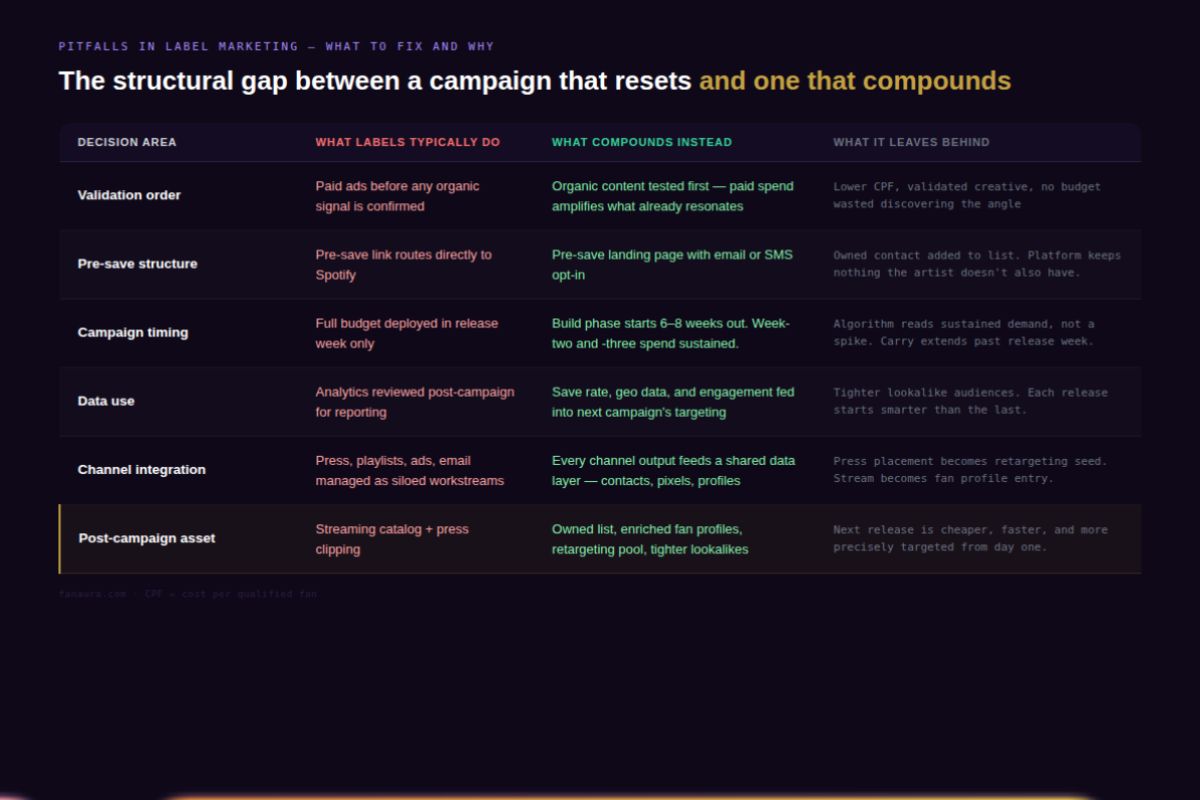
The common thread across every pitfall in label marketing is the same: each one is a decision that produces results on a single campaign and leaves nothing behind for the next one.
Fanaura is built to close exactly that gap - connecting the release cycle into a system where every fan interaction enriches the next campaign:
Organic signal validated before paid spend - content tested for genuine engagement before budget is allocated to amplification
Fan contacts captured at every pre-release touchpoint - email, SMS, and DM opt-ins built into every pre-save flow, not routed to Spotify directly
Behavioral data flowing across campaigns - save patterns, merch purchases, and RSVPs feeding back into targeting for the next release
Owned lists growing with every drop - direct communication channels that operate independently of any platform algorithm
That is what label marketing that compounds looks like - not a better campaign, but a better system. If the current approach leaves nothing behind when the promotional window closes, that is the gap worth addressing before the next release at fanaura.com.
Take the next step in your music career
Build your career with a marketing team behind you.
Create your account and start planning your next release with Aura Chat.