Successful influencer music campaigns: what separates a spike from a system
Successful influencer music campaigns are not built on follower count or lucky virality. They are built on structure, staggered timing, and a capture mechanism that turns discovery into owned fan contacts.
Successful influencer music campaigns share one structural characteristic that has nothing to do with budget or creator size: they are designed to leave something behind.
A campaign that generates a viral moment and ends leaves the artist with streaming data they do not own and a discovery event they cannot repeat.
A campaign designed around capture turns that same viral moment into fan contacts, retargeting pools, and behavioral data that make the next campaign cheaper to run and more precisely targeted from day one.
The difference is not the creators selected. It is the infrastructure built before the first post goes live.
What successful influencer music campaigns are actually optimizing for
Most campaigns are built around a metric that does not translate into career momentum. Views, impressions, and play counts are visible, they look like results.
They are not results. They are reach events. A listener who watches a creator's TikTok featuring a track, goes to Spotify, streams once, and moves on has contributed a view and a stream. The artist controls neither the relationship nor the contact.
Successful influencer music campaigns optimize for behavior, the kind that feeds the streaming algorithm and builds an owned audience simultaneously.
Saves, not streams. Pre-saves with opt-ins, not pre-saves routed directly to Spotify. Email or SMS contacts captured through DM automation, not listeners who disappeared into the platform.
The campaign structure that produces this: every creator post has a path attached to it. A keyword in the caption triggers a DM flow. The DM flow leads to a pre-save landing page. The landing page captures a contact before routing to Spotify. The listener who would have been a stream becomes a named contact with a source tag - acquired through creator X, on date Y, via TikTok.
The timing structure of campaigns that compound
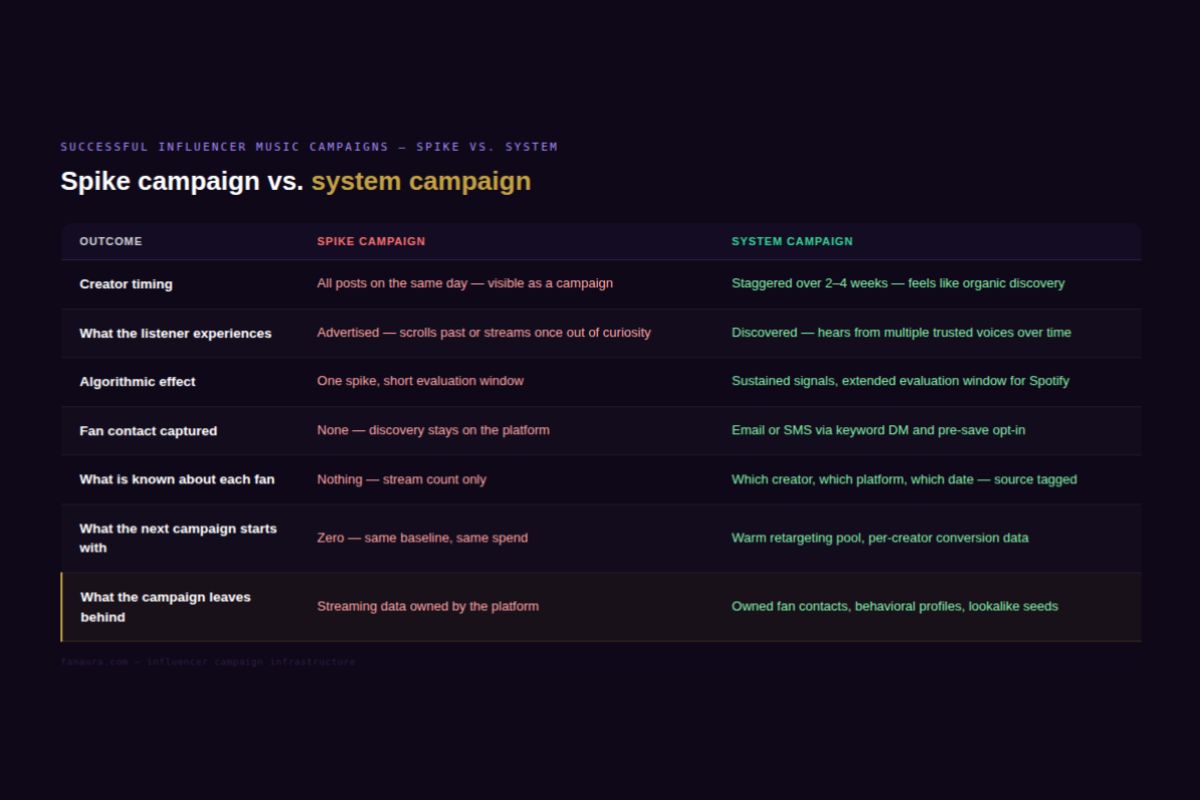
A single placement is a spike. A staggered campaign is a wave. The distinction determines whether the music feels advertised or discovered - and the algorithm treats them very differently.
When five to ten niche creators post about the same track on the same day, the audience sees a coordinated marketing event.
The trust that makes creator recommendations valuable evaporates the moment the campaign becomes visible as a campaign. Listeners scroll past ads. They pay attention to what their trusted sources discover.
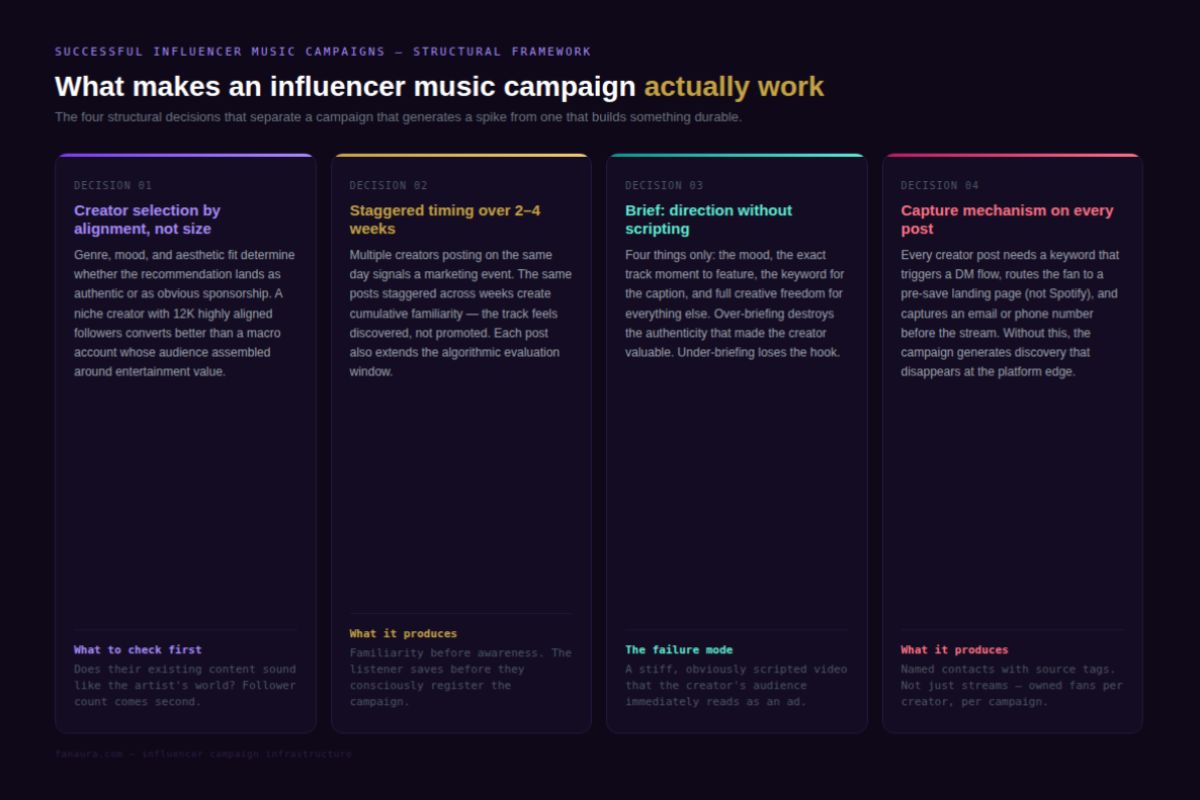
Staggering placements across two to four weeks produces something structurally different. The track arrives from different voices, in different contexts, over enough time for listeners to encounter it multiple times before they consciously register it.
Familiarity builds before awareness does. By the time the track is clearly recognizable, it already feels like something the listener found on their own - which is exactly when they save it.
The stagger also feeds the algorithm. Each new creator post generates a new engagement signal. Each new signal extends the window during which Spotify continues testing the track with new audiences.
A staggered campaign extends the evaluation window; a simultaneous one collapses it.
Briefing creators for music campaigns that convert
The brief is the most consequential document in any influencer campaign - and the most consistently mishandled. A brief that over-scripts the creator produces content the audience immediately reads as sponsored.
The creator's value comes from their authentic relationship with their audience. Over-briefing eliminates that value before the video is filmed.
A brief that converts gives the creator four things and nothing else:
The mood - not a genre label, but a specific feeling. "This is the track for a solo drive after a hard week" is more useful to a creator than "indie pop with lo-fi influences."
The exact moment - the specific section of the track, usually the most distinctive hook within the first ten seconds, that the creator should feature. Do not leave this to interpretation.
The call to action - a single keyword the creator drops in the caption or says in the video. This keyword triggers the DM automation that captures the fan contact. One clear action, not five.
The flexibility - everything else. Let the creator execute in their own format, their own voice, their own aesthetic. They know their audience better than the artist does.
The campaigns that fail on briefing fail in one of two ways: too much direction, producing stiff sponsored-feeling content; or too little direction, producing content that features the track in a context that misrepresents the music.
The brief holds both of those failure modes in tension. Getting it right is the creative work of the campaign.
What the capture mechanism looks like in practice
A successful influencer music campaign generates discovery. The capture mechanism is what converts that discovery into something durable.
The flow that works:
Creator posts with keyword in caption (example: "comment LINK for the track")
Fan comments the keyword
Instagram DM automation fires instantly with a landing page link - not a Spotify link
Landing page offers early access, exclusive content, or a behind-the-scenes bonus in exchange for email or phone
Fan opts in, receives the pre-save or stream link
Fan contact is added to the artist's owned list with creator source tagged
At the campaign's end, the artist has not just a stream count. They have a list of people who engaged with a specific creator's audience, opted in voluntarily, and can be reached directly - without depending on any platform to resurface the track.
That list becomes the seed audience for the next campaign. The more releases build on it, the tighter the targeting becomes and the lower the cost per qualified fan drops.
How Fanaura powers the capture layer behind influencer campaigns
The discovery side of an influencer campaign - finding creators, briefing them, timing the posts - is campaign work. The capture side is infrastructure work, and it has to be built before the first post goes live.
Fanaura handles the capture infrastructure:
Keyword DM automation - every creator campaign gets a dedicated keyword trigger. Fan engages with creator content, comments the keyword, enters the Fanaura DM flow.
Pre-save landing pages with opt-in - fan contacts collected before Spotify absorbs the relationship. Creator, date, and engagement source all tagged automatically on each profile.
Fan profile enrichment - every subsequent interaction from that fan - a merch click, a story reply, a pre-save on the next release - adds to the behavioral record started by the influencer campaign.
Retargeting pools per creator - by the next campaign, the team knows which niche audience clusters convert best and which creator partnerships are worth repeating.
Don't run another influencer campaign that resets after the last post. Set up your capture infrastructure with Fanaura before the next one drops - and turn every creator placement into a fan contact your next release can start from.
Take the next step in your music career
Build your career with a marketing team behind you.
Create your account and start planning your next release with Aura Chat.